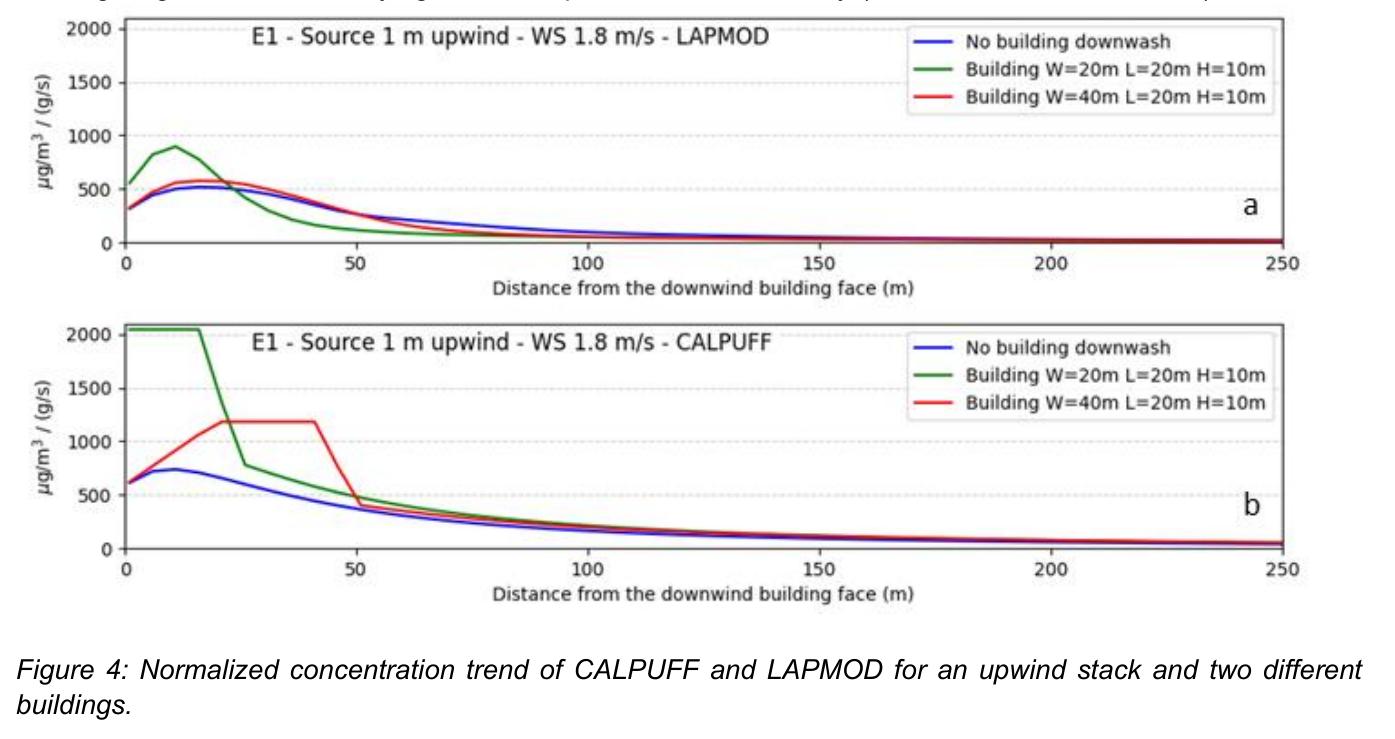
The open‑source Lagrangian particle model LAPMOD now incorporates the building downwash effect in its algorithm with PRIME2. Designed with odour in mind, it treats downwash at the particle level for point, area and volume sources, removes the need for BPIP preprocessing, and avoids the unrealistic “constant concentration” cavities that can appear with older schemes.

   Odour impacts are dominated by what happens in the first few tens to hundreds of metres from the source. In this near field, buildings can force plumes downwards, enhance turbulence and create recirculation zones that strongly affect ground‑level concentrations at nearby receptors. If a dispersion model gets the building wake wrong, it can easily under‑ or over‑estimate the very concentrations that determine whether neighbours complain or not. That makes the choice of downwash scheme critical for odour assessments around wastewater treatment plants, composting facilities, food processing sites and other installations with complex layouts.

   It is with deep sadness that we announce the passing of Domenico Cipriano, convenor of CEN/TC 264/WG 41 (“Emissions and ambient air – Instrumental odour monitoring”) within the European Committee for Standardization (CEN).

   Domenico was a senior researcher at RSE SpA (Ricerca sul Sistema Energetico) in Italy, where he led the research group on “Monitoraggio Agenti Chimici e Fisici” (Monitoring of Chemical and Physical Agents). An engineer by training (nuclear engineering, Politecnico di Milano), he devoted his career to air quality and emissions monitoring, combining scientific rigour with a commitment to standardisation and practical implementation.

   LabService Analytica S.r.l., through its InterCinD division, has opened registration for IC2026ODOR, an accredited proficiency test (PT) scheme for gas analysis. The scheme is organised in accordance with the standard EN ISO/IEC 17043:2023 and is designed to help laboratories assess their analytical performance under conditions that reflect routine practice.

   This edition covers two measurands: n-butanol and tetrahydrothiophene (THT). InterCinD will provide gas cylinders at two concentration levels for n-butanol and one set of cylinders for THT, allowing participants to evaluate both precision and accuracy within a structured interlaboratory comparison.

More Articles …

All the content here under Creative Commons license