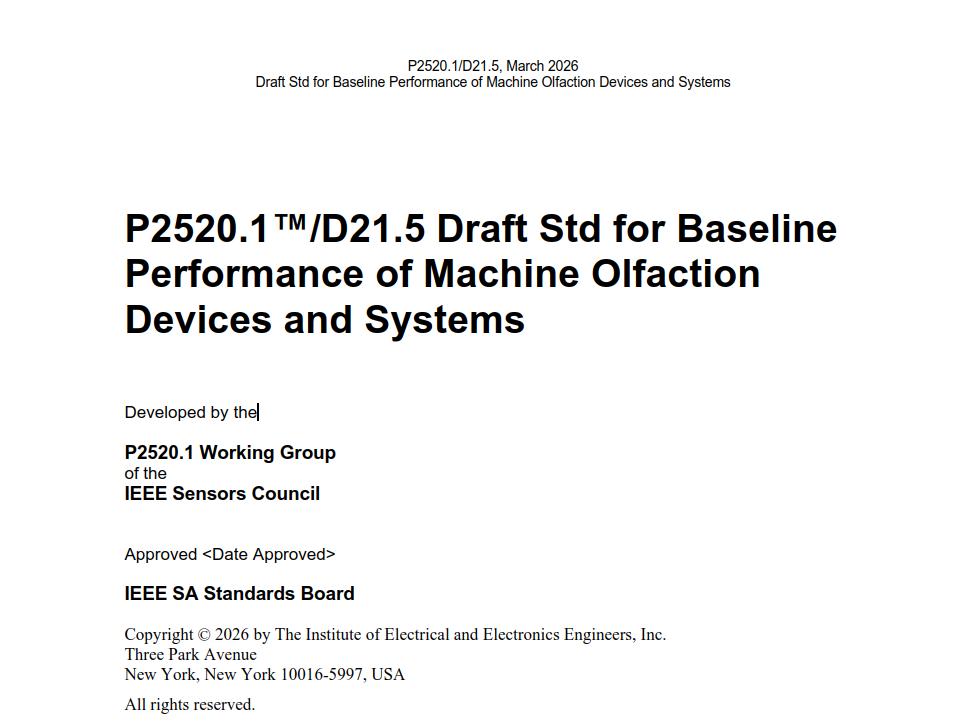
After a series or many meetings during the first months of the year, the IEEE working group developing the IEEE P2520.1 draft has reached its final stage of development, bringing the baseline standard for machine olfaction devices and systems closer to completion. This draft defines a common testing framework for these devices, with the goal of measuring their performance in differentiation, recognition, and quantification tasks.
The new IEEE standard P2520.1 is designed to provide a baseline performance standard that can be applied across a wide range of machine olfaction technologies. The document makes clear that it is intended as a foundation for the broader P2520 series, allowing more application-specific standards to build on top of a shared testing structure. Mr. James Covington, convenor of this initiative, recently talked about this new standard in the 24h-MOM.
The draft organizes evaluation into three levels. Level 1 checks whether the device can differentiate among three test chemicals; Level 2 measures whether it can recognize them correctly; and Level 3 assesses whether it can quantify them accurately. This tiered approach gives the standard flexibility while still maintaining a clear path to conformance.
Another important feature of the draft is its broad technical scope. It recognizes that machine olfaction systems may rely on many different sensing principles, including electrochemical sensors, field-effect transistors, mass-based sensors, spectroscopic methods, ion mobility, and gas chromatography approaches. That broad scope makes the document relevant to a wide range of instrument designs.
The draft also sets clear test conditions for temperature, humidity, pressure, and sampling behavior. It allows different sample introduction methods, including autosamplers, gas flow systems, sample bags, headspace methods, permeation tubes, and odor point sources, as long as the chosen method is used consistently throughout the evaluation.
Chemical selection is another key part of the standard. The operator must choose one of several predefined chemical groups, and the document ties the maximum reference concentrations to safety considerations and exposure limits where possible. This helps ensure that the test remains both technically meaningful and practically manageable.
This draft that has been approved within the working group, will follow a submission to IEEE-SA and the ballot process, with the goal of moving the document forward efficiently. After that, the procedure continues through public review, ballot participation, comment resolution, and possible recirculation if comments require changes. Once the ballot process is complete and approval is secured, the document can proceed toward publication, which may take up to 14 weeks after final standards committee approval.
If you find this article interesting, you might also be interested in these articles:
