ASTM International hat Ende August die E3412-25, "Standard Guide to Design, Conduct, and Analyze Sensory and Instrumental Data Relationships", als neue aktive Norm im BOS Band 14.03 veröffentlicht (DOI: 10.1520/E3412-25). Dieser 11-seitige Leitfaden enthält Protokolle für die Korrelation von geschulten Sensorik-Panel-Bewertungen mit instrumentellen physikalisch-chemischen Messungen für Lebensmittel/Getränke, Körperpflege-/Haushaltspflegeprodukte und Konsumgüter.

Instrumentelle und sensorische Analysen können in die Forschung integriert werden, um ergänzende, bestätigende oder beide Arten von Daten zu erforschen, die in der Regel die Produktentwicklung, Qualitätskontrollprozesse und sensorische Untersuchungen unterstützen. Die neue ASTM E3412-25 bietet kritische Überlegungen für die Planung, Durchführung, Analyse und Interpretation von Beziehungen zwischen analytischen sensorischen Bewertungen und instrumentellen Messungen.
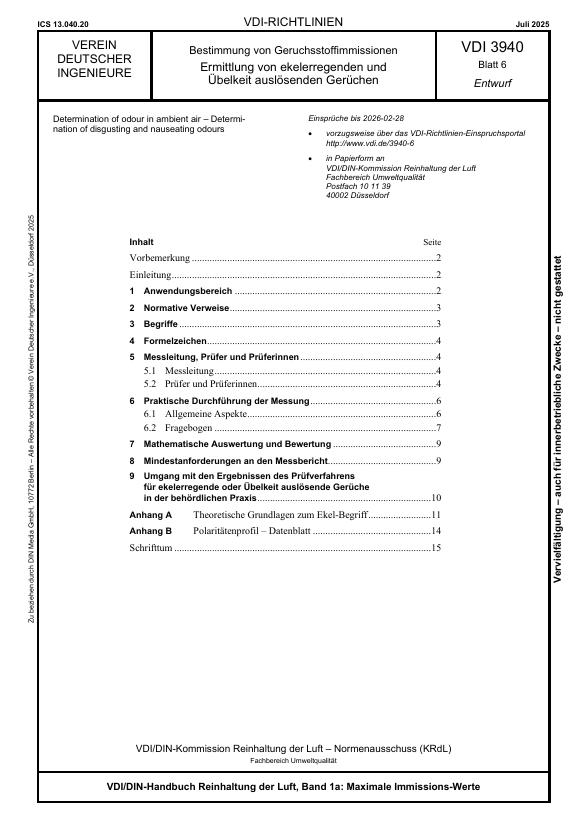
Der Entwurf der deutschen Norm VDI 3940 Blatt 6:2025-07 wurde im Juli dieses Jahres veröffentlicht. Dieser Text befasst sich mit der Bestimmung von ekelerregenden und übelriechenden Gerüchen. Die Norm befindet sich derzeit im Entwurfsstadium und nimmt Stellungnahmen von interessierten Kreisen entgegen.

Während der letzten zweijährlichen Tagung des Vereins Deutscher Ingenieure (VDI) zum Thema Geruchsmanagement in der Umwelt in Salzburg fanden mehrere interessante Vorträge statt. Einer davon entfernte sich von der Vorstellung, dass Geruch "nur eine Belästigung" ist. Der Vortrag von Dr. Kirsten Sucker beschäftigte sich nämlich mit der Frage, ob ein Geruch "nur" eine erhebliche Belästigung darstellt oder ob er so ekelhaft und unangenehm ist, dass er als schädliche Umwelteinwirkung eingestuft werden sollte. Doch was genau ist der Unterschied und wie kann dieser bestimmt werden?

There is no translation available.

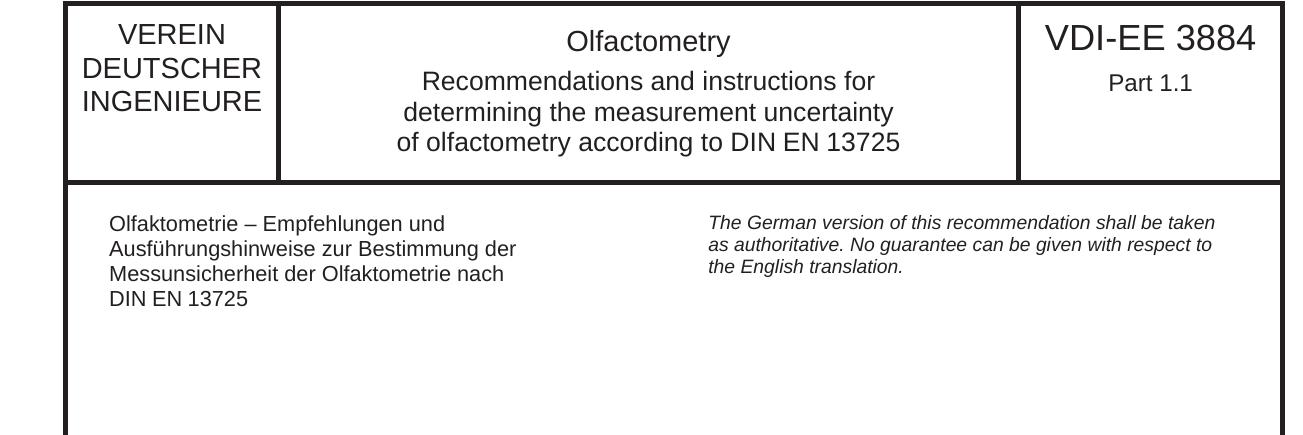
   The German standard for calculating uncertainty in odour measurements—VDI-EE 3884 Part 1.1—was officially published in October 2024. That is a year ago, so why did we wait that long to publish something about this new standard? because it is a bit complex and there is a bit of a history here. That history started during the development of the revission of the EN13725 a few years ago. In the conversations related to the calculation of the uncertainty, there were two groups there, one that we will call the "Italo-Dutch" school and another one being the "German" school. The thing is that the Italo-Dutch school finally developed this part. The reasons why that happened are well beyond this simple journalistic piece of text, but the Germans were not happy about it, and this was the begining of the path that led to the standard VDI-EE 3884 Part 1.1.

   The EN 13725:2022 standard came with a new set of statistical tools for calculating uncertainty. However, until now, work in certain areas related to the measurement of uncertainty in environmental samples had been purely theoretical. This aspect has undergone significant methodological revision in Germany in response to the results of a comprehensive comparative study. The new VDI-EE 3884 Part 1.1 standard modifies and corrects the method of calculating uncertainty, moving away from the core elements of the EN 13725:2022 standard.

Weitere Beiträge …

Unterkategorien

All the content here under Creative Commons license