There is no translation available.
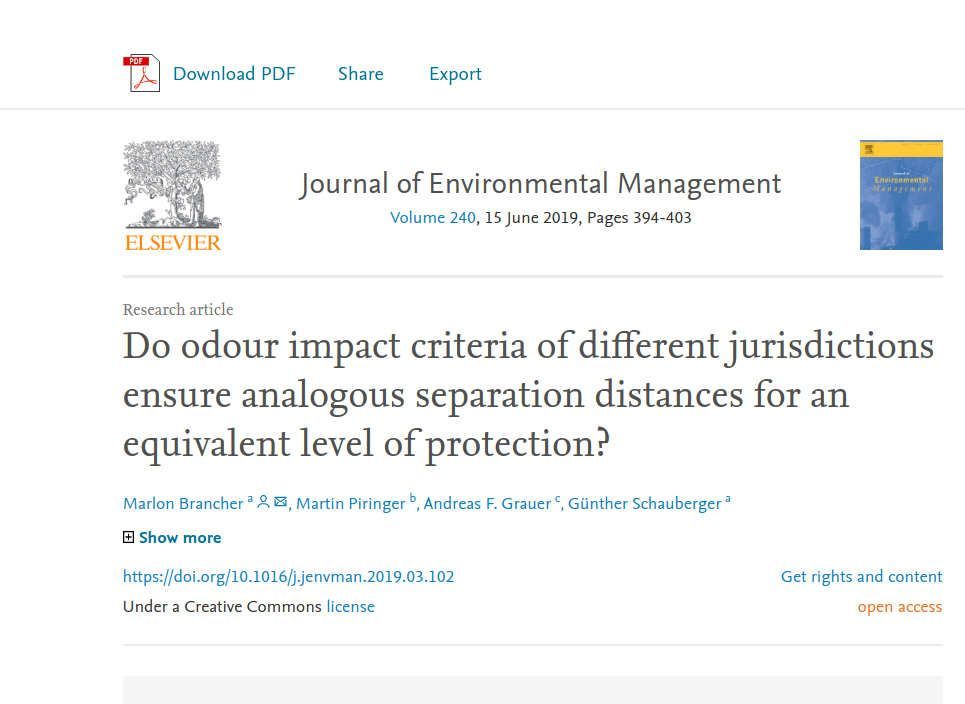 A very interesting and open access paper will be published this month in the Journal of Environmental Management. This paper is signed by the well-known experts Marlon Brancher, Martin Piringer, Andreas F.Grauer and Günther Schauberger and deals with the interesting topic of setting up separation distances to avoid odour impacts.
This study shows that the use of different odour impact criteria (OIC) produces different separation distances between odour sources and residential areas for an equivalent level of protection.
 D-NOSES stands for Distributed Network for Odour Sensing, Empowerment and Sustainability. This 3 year-long project is supported by International Associations, experts in citizen science, odour and sustainability experts, local administrations and public bodies. The important part of validation has just commenced with cases studies in Portugal, Spain, Greece and Bulgaria.
 The 19th and 20th of March, the Working Group (WG) 41 of the European Standard Organization met in Milan to discuss several issues related to Instrumental Odour Monitoring Systems (IOMS) or so called e-noses. This new standard was on the brisk of being downgraded to a technical specification, because the text developed by the experts was lacking a development on the first stage of Quality Assurance Level (QAL1), among other things.