There is no translation available.

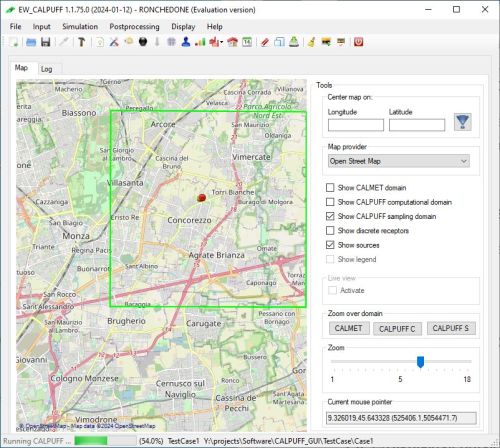
  Enviroware, an Italian company specialised in air quality consulting, has released version 7.2.1 of its EW_CALPUFF, a graphical user interface (GUI) dedicated to easily manage the Lagrangian puff model CALPUFF, widely used in atmospheric dispersion modelling for pollutants and odours.

  If you work with odour modelling, you are probably familiar with the dispersion model CALPUFF. This is a propietary, source-available (not open-source) non-steady-state Lagrangian puff model used to simulate pollutant transport, transformation, and deposition, taking into account time- and space-varying meteorological conditions. The official proprietary software (not open-source) CALPUFF core models (CALMET, CALPUFF, and CALPOST) are free to download and can be run via the command line, although the GUI requires a paid licence. In the past, there were several other GUIs available, such as CALPro, CALApps, Beeline, or MMS-CALPUFF but most of these have now been discontinued. Another well-known GUI is this one of the Italian company Enviroware that has been recently updated. This release introduces two new features.

There is no translation available.

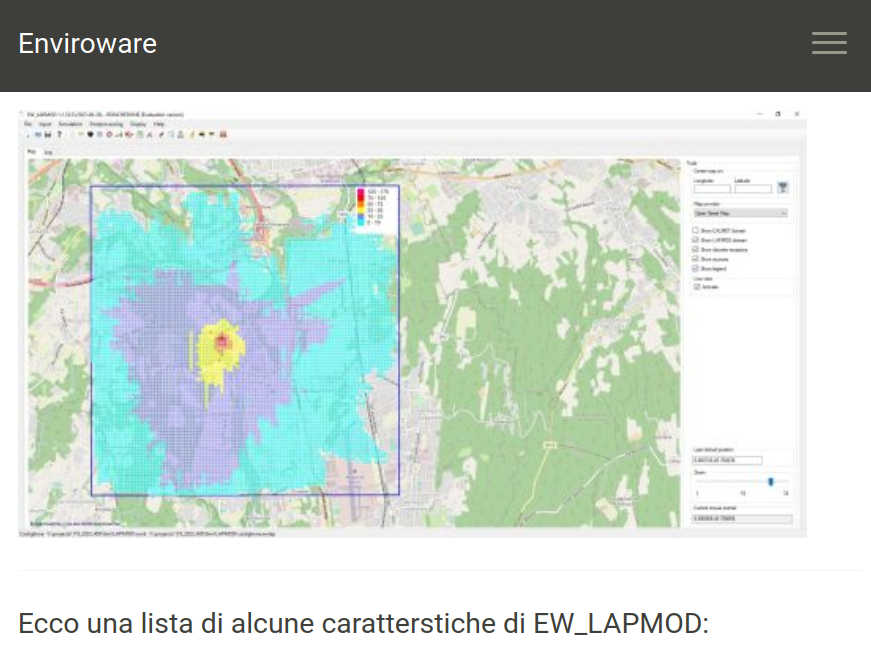
   The Italian company Enviroware is just on fire. They recently released an update of their CALPUFF GUI and also they published an update of their well-known model LAPMOD.  EW_LAPMOD is a graphical User Interface (GUI) designed for the Lagrangian particle model LAPMOD, an open-source tool used for simulating the dispersion of atmospheric pollutants. The software operates on Windows systems (we, linux users, will be missing it) and aims to simplify both the preparation of model inputs and the analysis of outputs generated by LAPMOD.

   Enviroware has released a new update to the official GUI for the propietary, source-available (not open-source) Lagrangian particle model LAPMOD, featuring two major new features:  

There is no translation available.

   Scentroid has introduced several improvements to its SIMS3 platform, enhancing the accuracy of emission plume visualization, integrating new monitoring hardware, and refining analytical tools for more robust odour event assessment. These updates aim to provide more reliable representations of atmospheric dispersion patterns and improve data interpretation in environmental monitoring applications.

   Recent developments in the Scentroid SIMS3 system focus on upgrading how emission plumes are modelled and displayed. The standard heatmap representation has been replaced by a custom visualization engine that ensures higher spatial resolution and stability at all zoom levels. This modification eliminates clustering effects common in dense measurement networks and provides better definition near emission sources, particularly under variable meteorological conditions. The result is a more consistent and realistic depiction of dispersion dynamics, improving the interpretation of odour and pollutant transport in complex environments.

Altri articoli …

All the content here under Creative Commons license