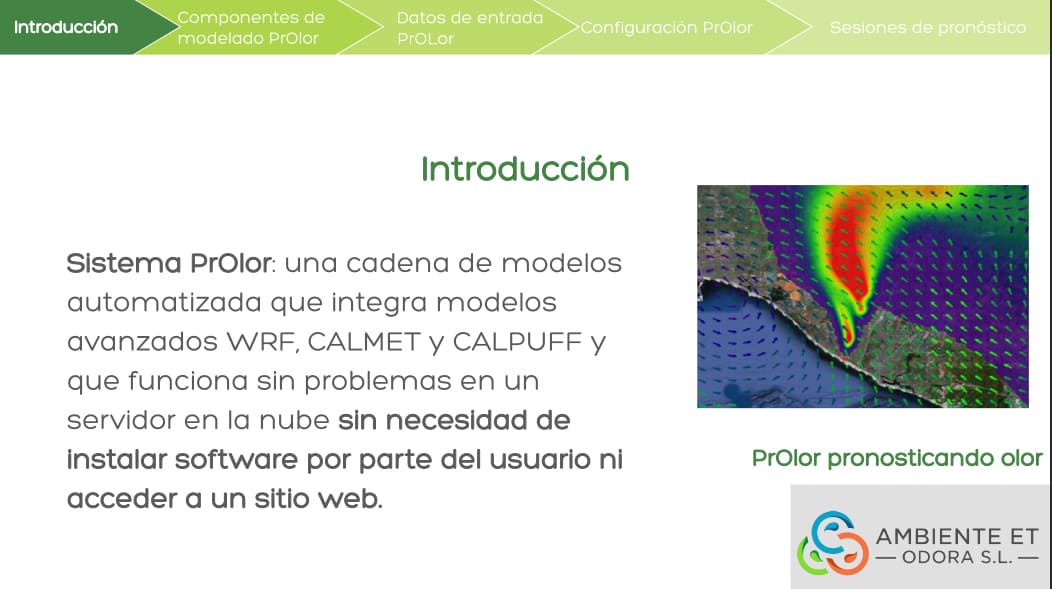
PrOlor is a simple odor impact forecasting system for composting plants that supports BREF BAT 37 recommendations by anticipating odor episodes in sensitive areas.
It uses meteorological and dispersion models (such as GFS, WRF, CALMET, and CALPUFF) run in the cloud to send daily odor threshold exceedance forecasts by email. The study also aims to compare these predictions with actual odor records at a specific composting plant.
C. Díaz1, C. Izquierdo1, A. Antón1, R. Bianconi2 & R. Bellasio2
1Ambiente et Odora. C/Uribitarte 6, planta baja. 48001, Bilbao, Bizkaia
1 carlosdiaz@ambienteetodora.com
2Enviroware. Via Dante Alighieri 142. 20863 Concorezzo (MB), Italy
Competing interests: The author has declared that no competing interests exist.
Academic editor: Carlos N. Díaz.
Content quality: This paper has been peer-reviewed by at least two reviewers. See scientific committee here.
Citation: C. Diaz, C. Izquierdo, A. Antón, R. Bianconi & R. Bellasio, 2025, PrOlor, a Simple Odour Forecasting Software, OLORES25 Congress, Santiago, Chile, www.olores.org.
Copyright: 2025 Olores.org. Open Content Creative Commons licence. It is allowed to download, reuse, reprint, modify, distribute, and/or copy articles on Olores.org website, as long as the original authors and source are cited. No permission is required from the authors or the publishers.
ISBN: pending.
Keywords: CALPUFF, odor forecast, complaints, odor threshold exceedance, atmospheric dispersion
Abstract
BREF Best Available Technique (BAT) 37 for waste treatment suggests two methods to control odor impacts at composting plants, including the recommendation “Take into account weather conditions and forecasts when carrying out major process activities outdoors. For example, avoid forming or turning trenches or piles, screening or shredding in case of adverse weather conditions in terms of dispersion of emissions.” To this end, it is useful to have predictive tools to anticipate odor concentrations in sensitive areas and issue alerts to avoid odor episodes and complaints. Odor impact forecasting tools do exist, but they tend to be complex and expensive. The PrOlor system stands out for its simplicity, sending a daily email with odor threshold exceedance forecasts. This system uses models such as GFS, WRF,CALMET and CALPUFF, run daily in the cloud. Finally, another objective of the present work is to compare the predicted data with real odor records and for this composting plant.
Video
1. Introduction
It is essential to have reliable tools to predict environmental odor concentrations near odor‑emitting plants. These tools should issue alerts when odor thresholds are likely to be exceeded. By acting on these alerts, plants can potentially reduce emissions during critical hours, avoiding odor episodes and minimizing complaints. Plant owners and managers can proactively address odor‑related issues, fostering community goodwill and ensuring efficient production processes.
The PrOlor system offers a simple solution. Users receive up to four emails per day highlighting future hours in which certain odor thresholds may be exceeded. PrOlor employs an automated model chain—integrating advanced GFS, WRF, CALMET, and CALPUFF models—that runs seamlessly on a cloud server without requiring user‑installed software or website access.
PrOlor runs automatically on a commercial cloud infrastructure, ensuring service uptime. It can simulate complex scenarios through configurable computational resources. In addition, PrOlor’s simple installation script allows for rapid global deployment.
In this work, we present a case study of a composting plant with a history of odor complaints. We demonstrate the effectiveness of capturing a complete snapshot of prevailing conditions by leveraging the PrOlor system together with a citizen science methodology following UNE 77270 standards and the incorporation of an odorant sensor.
2. Methodology
The modeling chain incorporated in PrOlor is based on WRF (https://www.mmm.ucar.edu/models/wrf) and CALWRF, CALMET, and CALPUFF from the CALPUFF modeling system version 7 (https://www.src.com). At the beginning of the pilot project, an odor nuisance evaluation was carried out in the sector using the survey method described in VDI 3883/1, a standard homologated in Chile as NCh 3387:2015.
2.1. WRF
WRF (Skamarock et al., 2008), the meteorological forecasting model incorporated in PrOlor, is the most widely used forecasting model in the meteorological modeling community, providing atmospheric parameterizations based on the current state of science.
In PrOlor, the WRF (ARW core) is run with 45 vertical levels, up to 50 mb, using three one‑way nested domains with increasing grid resolutions of 27 km, 9 km, and 3 km, respectively. The innermost WRF domain covers about 200 km in both longitude and latitude, with the dimensions of each nested domain being one‑third of its parent domain. An additional fourth nested domain can be activated at 1 km resolution for simulations in areas with especially complex orography.
2.2. CALWRF
CALWRF is a meteorological pre‑processor from the CALPUFF v7 system. It takes WRF model output and converts it into four‑dimensional fields to be used as input for CALMET. Additionally, a statistical analysis was conducted using citizen observations of wastewater odor collected during the pilot projects of D‑NOSES in Barcelona (Spain) and Castellanza (Italy).
2.3. CALMET
CALMET (Scire et al., 2000a) is a diagnostic meteorological model that reconstructs three‑dimensional wind and temperature fields and two‑dimensional micrometeorological variables using meteorological measurements, land‑use, and topographic data.
CALMET can also ingest WRF outputs. When performing a forecast, this input becomes essential and is the only required and available information.
2.4. CALPUFF
CALPUFF (Scire et al., 2000b) is an advanced, non‑steady‑state, multi‑species Lagrangian puff dispersion model that simulates the effects of temporally and spatially variable meteorological conditions on the transport, transformation, and removal of pollutants.
3. PrOlor Geophysical and Meteorological Input Data
3.1. Meteorological data
PrOlor uses the NCEP Global Forecast System (GFS), a forecasting model developed by the U.S. National Centers for Environmental Prediction (NCEP).
GFS provides global forecasts up to 384 hours ahead, updated four times per day, with a grid resolution of 0.25° × 0.25°.
GFS runs are issued at synoptic hours (0, 6, 12, 18 UTC), and data are freely available (https://www.nco.ncep.noaa.gov/pmb/products/gfs/).
These GFS datasets are used as initial and boundary conditions for running WRF at specific domains, enhancing spatial and temporal resolution.
3.2. Terrain elevation
For WRF, PrOlor uses GMTED2010 (Global Multi‑resolution Terrain Elevation Data 2010), a global digital elevation model (DEM) dataset developed by the U.S. Geological Survey (USGS) (https://www.usgs.gov/coastal-changes-and-impacts/gmted2010).
For CALMET, PrOlor employs SRTM (Shuttle Radar Topography Mission) data, originally developed by NASA. This high‑resolution (30 m at the equator) DEM covers large regions of the globe and is available from multiple repositories (e.g., https://earthexplorer.usgs.gov/).
3.3. Land‑use data
Both WRF and CALMET require land‑use datasets.
WRF uses MODIS land‑cover products (https://modis.gsfc.nasa.gov/data/dataprod/mod12.php), while CALMET uses Copernicus Global Land Operations Vegetation and Energy (CGLOPS‑1) products at 100 m resolution (https://lcviewer.vito.be/download).
4. PrOlor Setup
PrOlor requires an initial setup to configure the meteorological and dispersion domains. This involves a configuration script and template files to specify sources and receptors.
Assuming that WRF and the necessary global geophysical datasets are already installed on the server, the configuration script is run when creating a new domain for odor impact forecasting.
The user provides the coordinates of the dispersion domain center and the script runs with default settings, which can be overridden if necessary (e.g., domain extent).
The script generates the file system structure along with configuration/template files. Dedicated preprocessors prepare high‑resolution geophysical input for the CALMET model within the specified domain.
Finally, system administrators edit the template files to define source parameters (geometric and emission) and sensitive receptor coordinates. Notification email recipients are also specified.
5. Forecasting Sessions
In the server crontab, one or more PrOlor forecasting sessions are defined using custom scripts, executed automatically at predefined intervals.
PrOlor sessions are usually run every six hours, ensuring the newest GFS initialization data. For this reason, PrOlor begins four hours after GFS forecasts become available.
Each session starts by downloading GFS forecasts, followed by execution of the meteorological modeling chain (WRF → CALWRF → CALMET), and then the dispersion modeling chain (CALPUFF → post‑processing).
Finally, PrOlor sends email notifications to selected recipients based on results, either reporting compliance with concern levels at receptors or issuing alerts when thresholds are exceeded.
6. Application to a Composting Plant
We present a case study of a newly built composting plant with a history of odor complaints. Over the course of one year, odor logs were collected by residents of a nearby town more than 2 km away from the plant, following a citizen science methodology aligned with UNE 77270 standards, in addition to continuous monitoring of an odorant sensor (ammonia).
Using mobile app entries recording odor observations with exact location and time metadata, these records were compared with PrOlor forecasts for nearly 6 months (04/08/2023–15/01/2024). During this period, 465 odor reports were received, most of them in summer.
Different statistical analyses (Díaz et al., 2015) will be carried out to identify significant correlations between forecasted odor concentrations, reported time and location, observed intensity, wind speed and direction, and continuous sensor data.
This analysis has not yet been completed, as the project is ongoing, but results are expected to be available for presentation at the conference.
7. Conclusions
The complex PrOlor system, which integrates advanced GFS, WRF, CALMET, and CALPUFF models into an automated modeling chain, results in an apparently simple interface for end users (process managers). This supports decision‑making during activities that might cause odor nuisance for nearby sensitive receptors.
Furthermore, we presented a real case study at a composting facility where citizen odor complaint data and continuous odorant monitoring were used to validate and analyze modeling results.
8. Bibliography
AENOR. UNE 77270:2023 - Construcción de mapas de olor colaborativos mediante ciencia ciudadana. CTN 77/SC 2/GT 1.
Díaz C.N., Izquierdo C., Cartelle D., Vellón J.M., Rodríguez A., 2015, PrOlor, Pronostica el Olor Dos Días Antes. Caso de Estudio en una Planta de Procesado de SANDACH. III Conferencia Internacional sobre Gestión de Olores en el Medio Ambiente, Bilbao. Olores.org
Scire J.S., Robe F.R., Fernau M.E. y Yamartino R.J.: 2000a, A user's guide for the CALMET meteorological model (Version 5.0).
Scire, J.S., D.G. Strimaitis y R.J. Yamartino, 2000b, A user's guide for the CALPUFF dispersion model (Version 5). Earth Tech. Inc., Concord, MA.
Skamarock, W. C., Klemp, J. B., Dudhia J., Gill, D. O., Barker, D. M., Duda, M.G., Huang, X.-Y., Wang, W., y Powers, J. G, 2008, A Description of the Advanced Research WRF Version 3, Centro Nacional de Investigación Atmosférica, Boulder, Colorado.