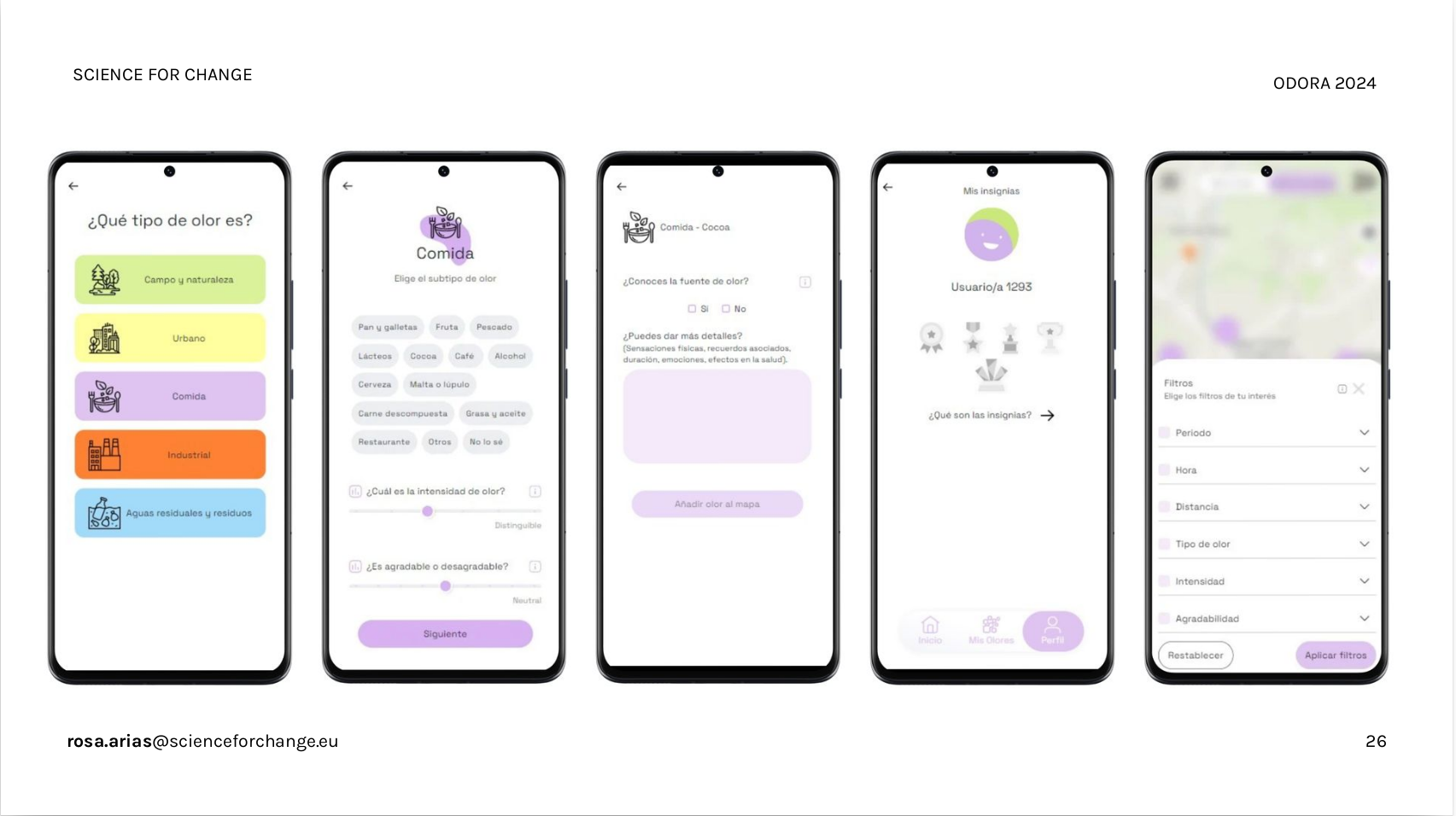
Traditional methodologies for evaluating odour pollution are effective in most cases but insufficient for complex situations with multiple sources and various odours.
OdourCollect, developed by Science for Change, offers a comprehensive citizen science-based solution for odour monitoring and management, complying with the UNE 77270:2023 standard. The platform centralizes information and enables real-time analysis, encouraging citizen participation and integrating additional data for improved decision-making.
Rosa Arias. Johana Burbano
C. de Vilamarí, 50, Planta 7, Eixample, 08015 Barcelona
rosa.arias@scienceforchange.eu
Competing interests: The author has declared that no competing interests exist.
Academic editor: Carlos N. Díaz.
Content quality: This paper has not been peer-reviewed.
Citation: Rosa Arias. Johana Burbano, 2024, OdourCollect: Environmental management platform for building collaborative odour maps according to UNE 77270:2023 standard, ODORA24 Conference, Barakaldo, Spain, www.olores.org.
Copyright: 2025 Olores.org. Open Content Creative Commons licence. It is allowed to download, reuse, reprint, modify, distribute, and/or copy articles in Olores.org website, as long as the original authors and source are cited. No permission is required from the authors or the publishers.
ISBN: pending.
Keywords: UNE 77270:2023, citizen science, odors, collaborative odor maps.
Abstract
Traditional methodologies for evaluating odour pollution have proven effective in most cases, although they are limited when facing complex situations that involve multiple emitting sources and a variety of odours, affecting different communities. These complex situations represent approximately 30% of odour impact cases, highlighting the need to apply citizen science methods to identify the origins and to objectify the scope of the problem from the citizens’ perspective. It is here where OdourCollect, developed by Science for Change, offers a complete solution for the monitoring of odour pollution, based on citizen participation and in line with the technical standards of UNE 77270:2023 “Construction of collaborative maps through citizen science,” which it enables compliance with.
The OdourCollect environmental management platform centralizes all relevant information in a single place, allowing for simple and quick access. Through citizen observations, data is collected in real time about air quality, calculating the levels of annoyance associated with odour episodes. This facilitates the identification and characterization of the areas affected by odour pollution.
The development of this platform has carefully considered the behavior of the relevant variables, whose precise definition is fundamental for the evaluation of odour episodes. The platform provides a space for environmental consultants and odour experts to analyze the results of citizen science projects in real time, in a practical and accessible manner, analyzing the plausibility of odour episodes in relation to the location of odour observations, the typology of the reported odour, the location of the emitting sources, and the meteorology. It allows sending alerts and establishing communication mechanisms with both emitting authorities and participating citizens, as well as sending automatic periodic reports. Additionally, it offers the possibility of integrating additional data for a deeper understanding of the impact of odour and its evolution, thus facilitating informed decision-making and the integration of the methodology with data from sensors, electronic noses, or others. Finally, this learning process has led to a critical evaluation of the existing standard, UNE 77270:2023, identifying possible areas for improvement.