There is no translation available.
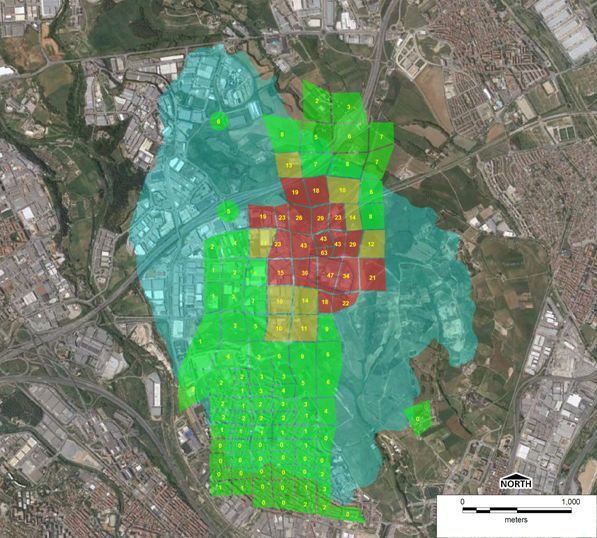 The use of general purpose steady state Gaussian models (e.g. AERMOD) for predicting Odour exposure levels around the vicinity of an industrial site has been considered an accepted practice for many countries around the world for more than a decade now.
Murguia Walter1, Pagans Estel·la2, Heike Hauschildt3
1. Odournet México, Jardines de Madrid 7622, Monterrey, México. wmurguia@odournet.com T. +52 (55) 5677 1319
2. Odournet SL, Parc de Recerca UAB · Edificio Eureka, Barcelona, Spain.
3. Odournet Gmbh, Frauenhoferstr. 13, Kiel, Germany.
 The present work is a joint venture project conducted by the Uruguayan Technological Laboratory (LATU), the National Directorate of the Environment (DINAMA) and the Río Negro’s local government. It consists on the application of different methodologies to address the problem generated by the presence of unpleasant odours in Fray Bentos, Uruguay.
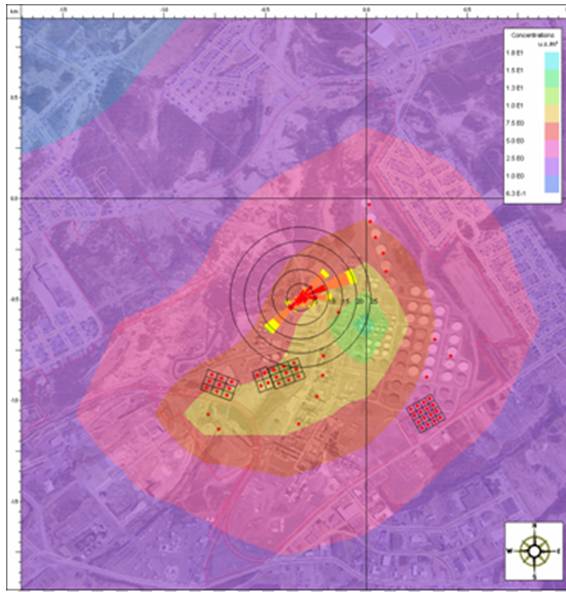 Dispersion modeling defines the relationship between the emission source and the receptor. While control measures may be applied to the emission source, compliance with odor nuisance standards depend on whether the odor concentrations at the receptor have been adequately reduced with respect to their frequency, intensity, duration and location.