There is no translation available.
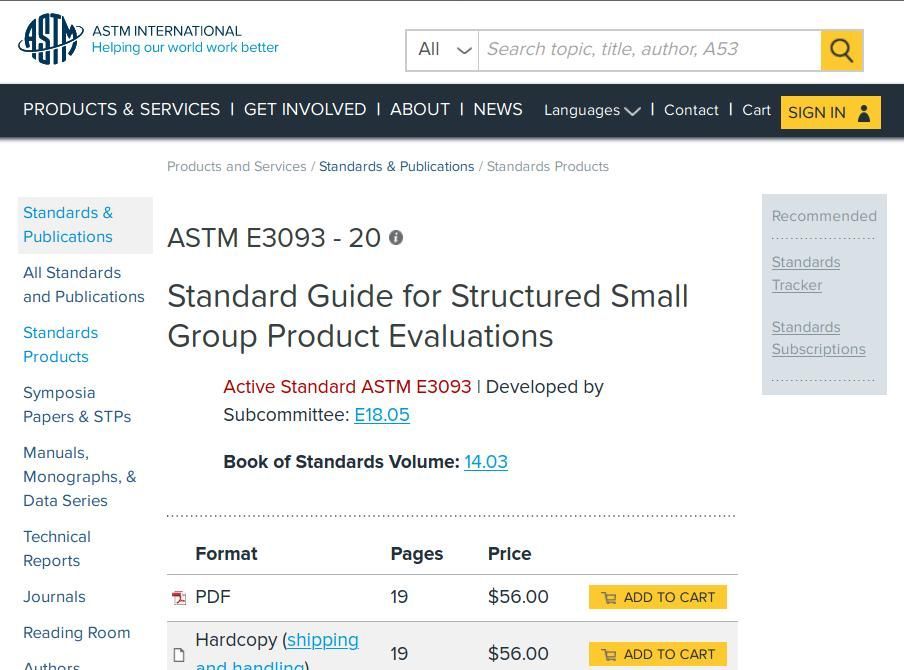 ASTM E3093 - 20 is a standard guide for structured small group product evaluations (SPGE). It was first published last year and now it is undergoing some changes to further clarify some tables and sections.
This guide covers those occasions in which a small group of individuals (generally between three and ten) with potentially different functional roles and degrees of training in sensory and product evaluation, evaluates a product or series of products for a specific objective, with a pre-identified decision to be made, but without the use of formal hypothesis testing or statistics.
According to the ASTM E3093 - 20, the aim of this guide is to provide best practices to ensure that SGPE are conducted with sufficient rigor to enable the most appropriate decision or to yield the needed learning while considering the risk. Because the participants may be heterogeneous with respect to functional role, knowledge of the issue at hand, sensory sensitivity, and degree of sensory or product evaluation training, the likelihood of agreement on a path forward is not assured. Additionally, participants may have certain biases with respect to the issue to be decided, because of prior knowledge or their role within the organization.
These potential derailers can be addressed through proper planning and execution of an SGPE. When SGPE are unstructured, unfocused and experimental error and biases uncontrolled, the outputs of SGPEs do not inform decisions or deliver the desired learning in a scientific manner. The goal of this document is to elevate the practice of small group product evaluations by outlining a structure, defining decision criteria in advance, and providing guidelines for implementation, drawing upon existing sensory theory and methods. Outputs from these SGPE are used to inform decisions and determine next steps including the risks involved with each of these.
This revision is needed to help readers understand Table 4 better. Several minor wording have been changed in Sections 10.3, 10.4.1 and 10.5 for additional clarity. Footnotes to Table 4 have been added to make it clear to the reader how the numbers are calculated. The guideline have been edited to make it easier for the reader to know what the text is referring to in Case Study 3.
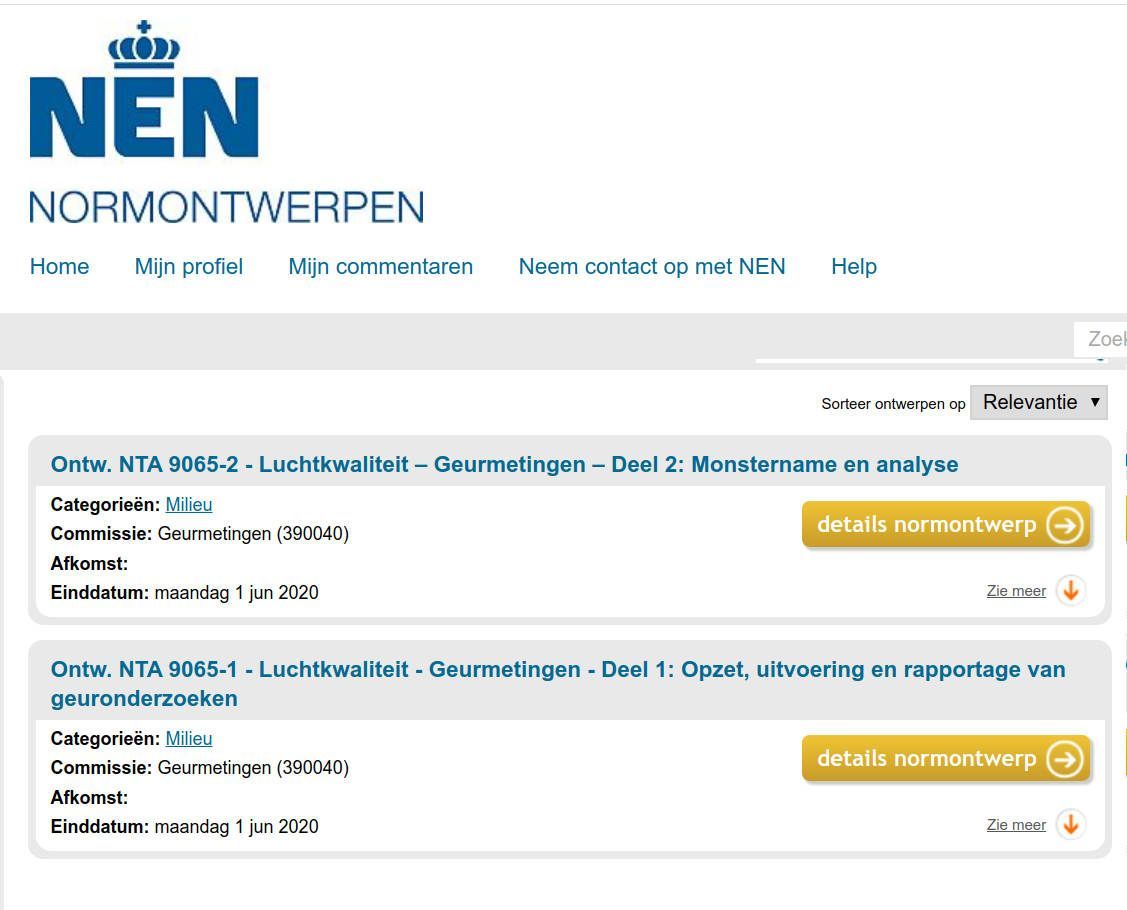 La norma holandesa NTA 9065 sobre medición y cálculo de olores se publicó por primera vez en el año 2012. Ahora, 8 años más tarde, una revisión de esta norma está lista para consulta pública hasta el 1 de junio de 2020. El texto proporciona los requisitos e instrucciones para el procedimiento estándar para la realización de pruebas de olor en los Países Bajos y se ha dividido en 2 partes: NTA 9065 Parte 1 que trata de la planificación, ejecución y presentación de informes de las investigaciones sobre olores y NTA 9065 Parte 2 que trata de la toma de muestras y análisis.
  This ASTM document deals with standard terminology relating to sensory evaluation of materials and products and it is the 33rd revision of the original text published in 2000. This text is developed by the subcommittee: E18.01.