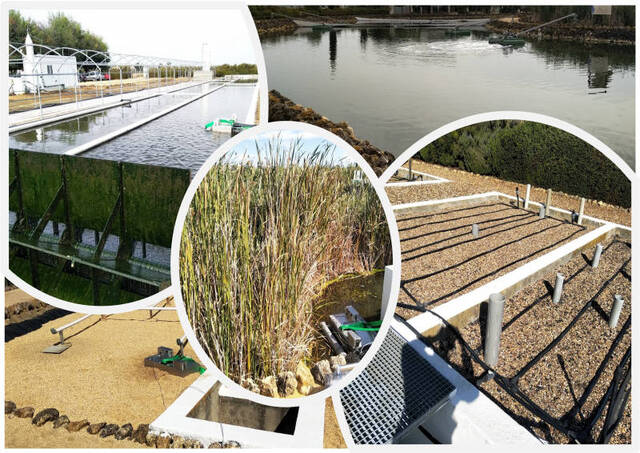
The emission of unpleasant odors in wastewater treatment plants is mainly due to the treatment of biological sludge, due to its high organic matter concentration. This study, conducted by CENTA in Carrión de los Céspedes (Seville), evaluates the efficiency of organic matter and nutrient removal, as well as the derived odor emissions from various technologies.

   The highest odor emission rates were found in anaerobic lagoons, facultative lagoons, and septic tanks. Two indices were defined to relate odor emissions to the efficiency of organic matter removal (OGIC) and combined organic matter and nitrogen removal (OGICN). The highest efficiency values were found in free-flowing gravel wetlands and anaerobic lagoons. A principal component analysis grouped the technologies evaluated based on hydraulic retention time and pH.

Gutiérrez, M.C. 1*, Martín, M.A. 1, Ruiz-Muñoz, A. 1, Márquez, P. 1, Toledo, M. 2, Salas, J.J. 3, Siles, J.A. 1

1 Departamento de Química Inorgánica e Ingeniería Química (Área de Ingeniería Química). Facultad de Ciencias, Universidad de Córdoba. Instituto Químico para la Energía y el Medioambiente (IQUEMA). Campus de Excelencia Internacional Agroalimentario (ceiA3). Campus Universitario de Rabanales. Carretera N-IV, km 396, 14071. Córdoba, España.
2 Instituto de Procesos Sostenibles, Área de Ingeniería Química. Universidad de Valladolid. Dr. Mergelina, s/n, Valladolid, 47011, España.
3 Fundación Centro de las Nuevas Tecnologías del Agua (CENTA). A-49, km 28. 41820. Carrión de los Céspedes, Sevilla, España.
* mc.gutierrez@uco.es
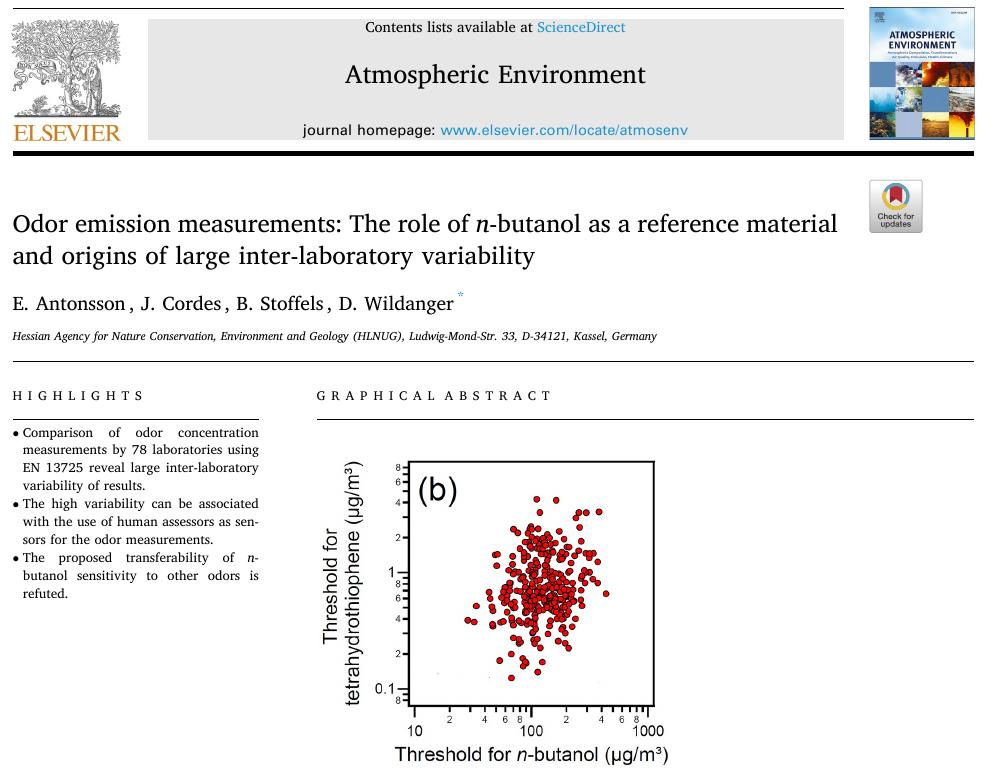
   In June this year, Mr Antonsson and his collaborators dropped a bombshell on the waterline of the standard governing dynamic olfactometry with the publication of their scientific paper published in Atmospheric Environment. The EN 13725 standard assumes that assessors' sensitivity to 1-butanol is transferable to other odours. However, the study reveals that this sensitivity transfer is not valid for other odorous substances, calling into question the uniform application of the standard.

   You may imagine how much debate this research has generated. We have participated in threads and threads of conversations with several world experts in odour management, commenting on the results of the following paper. The paper analyses the reproducibility of odour testing using the EN 13725 standard. The study focuses on the variability of results between different laboratories and how the selection of assessors and the number of repetitions influence that variability. These are some key findings of the paper.

InterCinD, a specialized division of Lab Service Analytica Srl, has announced the opening of registrations for this year's Proficiency Test (PT) for Olfactometry, adhering to the new EN 13725:2022 standard. This annual event invites all European olfactometric laboratories to participate and confirm their compliance with the latest performance criteria. This is one of the PT and is an alternative to the well known olfasense PT.

Proficiency tests (PT) are key to ensure a laboratory's compliance with EN 13725:2022. and join this proficiency test to benchmark your performance in olfactometry.

More Articles …

All the content here under Creative Commons license