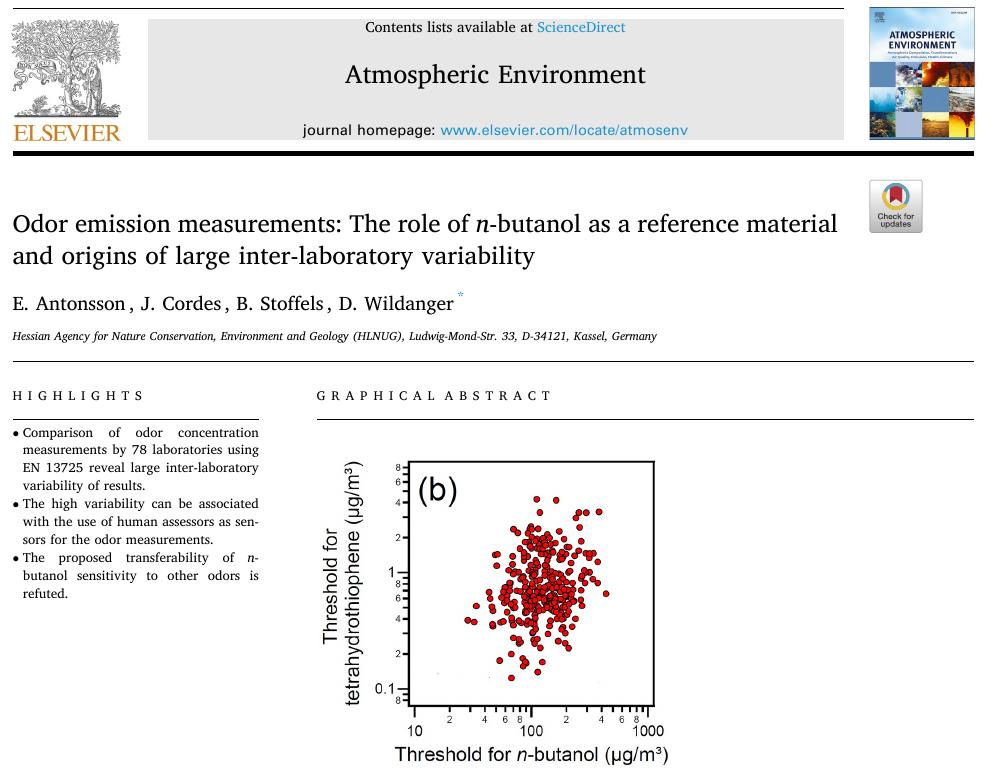
In June this year, Mr Antonsson and his collaborators dropped a bombshell on the waterline of the standard governing dynamic olfactometry with the publication of their scientific paper published in Atmospheric Environment. The EN 13725 standard assumes that assessors' sensitivity to 1-butanol is transferable to other odours. However, the study reveals that this sensitivity transfer is not valid for other odorous substances, calling into question the uniform application of the standard.
You may imagine how much debate this research has generated. We have participated in threads and threads of conversations with several world experts in odour management, commenting on the results of the following paper. The paper analyses the reproducibility of odour testing using the EN 13725 standard. The study focuses on the variability of results between different laboratories and how the selection of assessors and the number of repetitions influence that variability. These are some key findings of the paper.
- Transferability of the n-butanol threshold:
The EN 13725 standard assumes that assessors' sensitivity to 1-butanol is transferable to other odours. However, the study reveals that this sensitivity transfer is not valid for another odorant (tetrahydrotiophene), calling into question the principle of 1-butanol transferability. - Variability between laboratories:
The variability of results between laboratories is significant and influenced by several factors, including the strategy for selecting panellists. Laboratories that select panellists with similar odour thresholds tend to show less internal variability, but this does not translate into lower variability between laboratories. In fact, non-random selection of assessors can increase differences between laboratories. - Effect of panel size and number of rounds:
While increasing the number of assessors and repetitions within a laboratory reduces internal variability (improves repeatability), it has a limited effect on reducing variability between laboratories (reproducibility). This is because internal variability is less important than individual differences in odour sensitivity among assessors. - Panel optimisation:
Some laboratories in Germany opt to change assessors according to the type of odour being measured (referred to as "panel optimisation"). This reduces internal variability within the laboratory but simultaneously increases differences between laboratories by not following a random process for selecting assessors.
This is not the first time that the use of 1-butanol has been called into question. For example, Feilberg et al. already pointed out about this issue. The difference now is that this new study has been carried out by analysing results from 78 laboratories, which makes it considerably more robust.
Over the course of ten years, the development meetings for the EN 13725:2022 standard were marked by numerous in-depth discussions on various topics. In fact, there were many discussions also on some of these topics during the meetings. This thorough approach ensured that every aspect was carefully considered, contributing to the robustness of the standard.
In one of the group meetings developing the EN 13725:2022 standard in Barcelona in 2017, a representative from the HLNUG (previously known as HLUG) presented some of these results, but not all.
The standard EN 13725:2022 provides a procedure for using an SROM (Secondary Reference Odour Mass) if someone feels that the use of 1-butanol is not adequate. However, the sensitivity of the SROM must be compared to that of 1-butanol. Some previous work by Curren et al. did find 1-butanol to be a good tool to evaluate intensity of as compared to the use of a sugar intensity scale used in drinking water with great success. Both methods delivered similar results when measuring the intensity of several suprathreshold concentrations of dimethyl sulfide and butyric acid.
However, Antonsson et al. paper suggests that the EN 13725:2022 standard may need to be revised again. Could this be the start of a new working group on the standard? We have yet to find out.
Some rumours suggest that our German colleagues intend to lead this latest development, given their experience in this field. To their credit they have the publication of the first Air Quality law in Europe with odour limit values. Also, the former Dutch convenor of the last two revisions of EN 13725:2022 is already retired after over 20 years of voluntary work, which is not too bad. So stakes are high to see who is the next convenor.
Should you wish to know more, acquire the paper at the following link.
If you find this article interesting, you might also be interested in these articles:
- Limit values for odour in ambient air – A legal system applied all over Germany
- Is this the end of n-butanol for olfactometry?
- Odours in the Environment, a different kind of conference organised by the Association of German Engineers VDI
- EN 13725:2022 is finally published!
- Last meeting of the Working Group 2 dealing with the revision of the current standard on dynamic olfactometry
