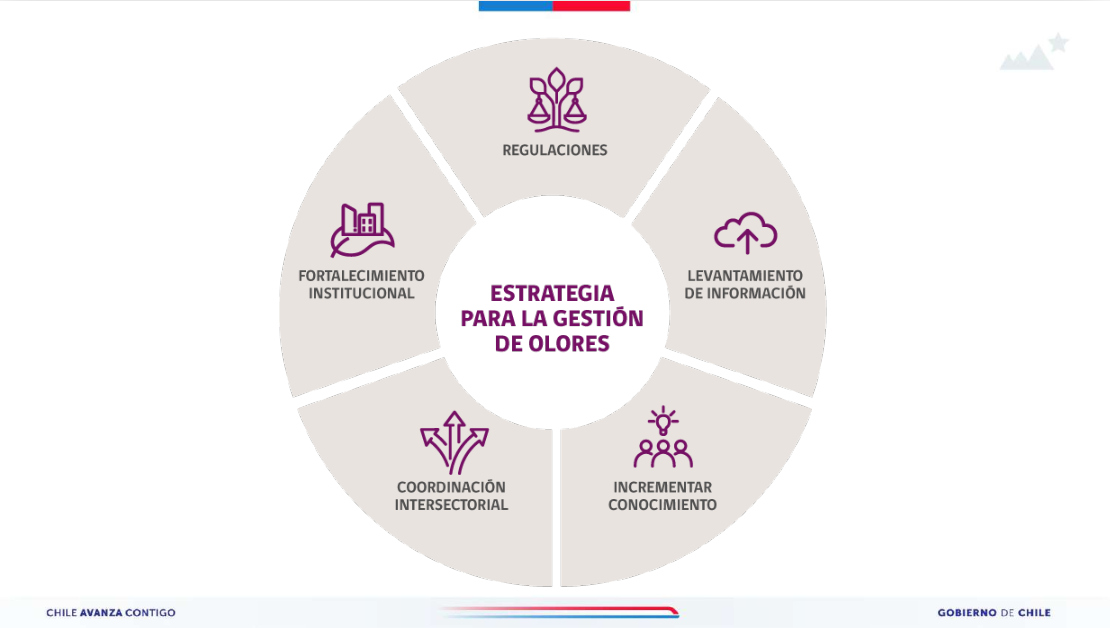
The Odour Management Strategy in Chile has resulted in regulatory advances, such as the first environmental odour standard for pig farming, but citizen complaints remain high.
This study reviews the current state of odour management and outlines planned actions, including sector-specific emission standards and improved implementation. Future efforts will focus on stronger regulations, municipal management with community involvement, and integration with climate change policies. The goal is to enhance odour prevention and control, improving quality of life for affected communities.
D. Caimanque1
1 Departamento de Ruido, Lumínica y Olores. División Calidad del Aire, Ministerio del Medio Ambiente de Chile. San Martín 73, Santiago - Chile.
* dcaimanque@mma.gob.cl
Competing interests: The author has declared that no competing interests exist.
Academic editor: Carlos N Díaz.
Content quality: This paper has been peer-reviewed by at least two reviewers. See scientific committee here.
Citation: D. Caimanque, 2025, Present and Future of Odour Management in Chile, OLORES25 Congress, Santiago, Chile, www.olores.org.
Copyright: 2025 Olores.org. Open Content Creative Commons licence. It is allowed to download, reuse, reprint, modify, distribute, and/or copy articles on Olores.org website, as long as the original authors and source are cited. No permission is required from the authors or the publishers.
ISBN: pending.
Keywords: Pollution, Air Quality, Odours, Regulation, Strategy.
Abstract
The implementation of the Odour Management Strategy in Chile has led to key advances in regulation, including the first environmental odour standard for the pig farming sector. However, citizen complaints continue to be significant, evidencing the persistence of the problem. This study aims to report on the current state of odour management in Chile and to identify actions planned for the next update of the Strategy. Current actions include the development of emission standards by productive sector, with differentiated approaches, as well as initiatives that have facilitated their implementation. In the future, a strengthening of these regulations, a municipal odour management with a citizen approach and the integration with climate change policies, focusing on the reduction of methane emissions and the circular economy, are foreseen. It is expected to consolidate effective actions for the prevention and control of odours, thus improving the quality of life of affected communities.
See the full article in other languages:
- French
- Spanish
- German
- Polish
- Arabic