This project demonstrates that multisensor systems with electrochemical sensors, enhanced by Data Learning models, can accurately and reliably monitor hydrogen sulfide (H2S) in wastewater treatment plants without costly or frequent manual calibration.
The pilot phase, conducted in early 2024, achieved excellent agreement with reference analyzers, offering a low-cost, low-maintenance, and innovative solution for continuous H2S measurement in WWTPs..
M. Padilla, S. Udina, E. Flores, M. Escribano, F. Ramírez, J. Perelló
Bettair Cities S.L.
Competing interests: The author has declared that no competing interests exist.
Academic editor: Carlos N. Díaz.
Content quality: This paper has not been peer-reviewed.
Citation: M. Padilla, S. Udina, E. Flores, M. Escribano, F. Ramírez, J. Perelló , 2024, Advances in H2S Detection in Water Treatment Plants: Integrating Machine Learning into IOT Sensors for Efficient Measurement, ODORA24 Conference, Barakaldo, Spain, www.olores.org.
Copyright: 2025 Olores.org. Open Content Creative Commons licence. It is allowed to download, reuse, reprint, modify, distribute, and/or copy articles in Olores.org website, as long as the original authors and source are cited. No permission is required from the authors or the publishers.
ISBN: pending.
Keywords: Odours, odorants, IoT sensors, Machine Learning, H2S, WWTP, gas monitoring..
Abstract
Wastewater Treatment Plants (WWTPs) must continuously measure and manage hydrogen sulfide (H2S) levels, a harmful gas for infrastructure and operator health.
Traditionally, monitoring is performed with reference analyzers, which are accurate but expensive and require frequent calibration.
This project explores the capability of multisensor measurement systems equipped with electrochemical sensors to measure H2S with high precision and minimal intervention, leveraging advances in Data Learning to compensate for sensor degradation and environmental variations without the need for manual calibration with standard gas, either in the factory or in the field.
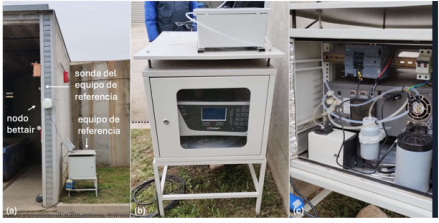
This report presents part of a global validation and deployment project running during 2024. Specifically, the phase reported here, from February to May 2024 - awaiting further results - focused on the implementation and analysis of sensors in a WWTP, where data collected were compared with those of an H2S analyzer. The excellent statistical results show hourly data with a determination coefficient (R²) of 0.92, a Mean Absolute Error (MAE) of 12 ppb, and a Root Mean Square Error (RMSE) of 19 ppb, highlighting the quality and reliability of the generated data.
This pioneering approach, characterized by its low cost, lack of calibration with standard gas, and effective use of Data Learning models, provides a viable solution for H2S monitoring in WWTPs.
See the full article in other languages:
- French
- Spanish
- German
- Polish
- Arabic