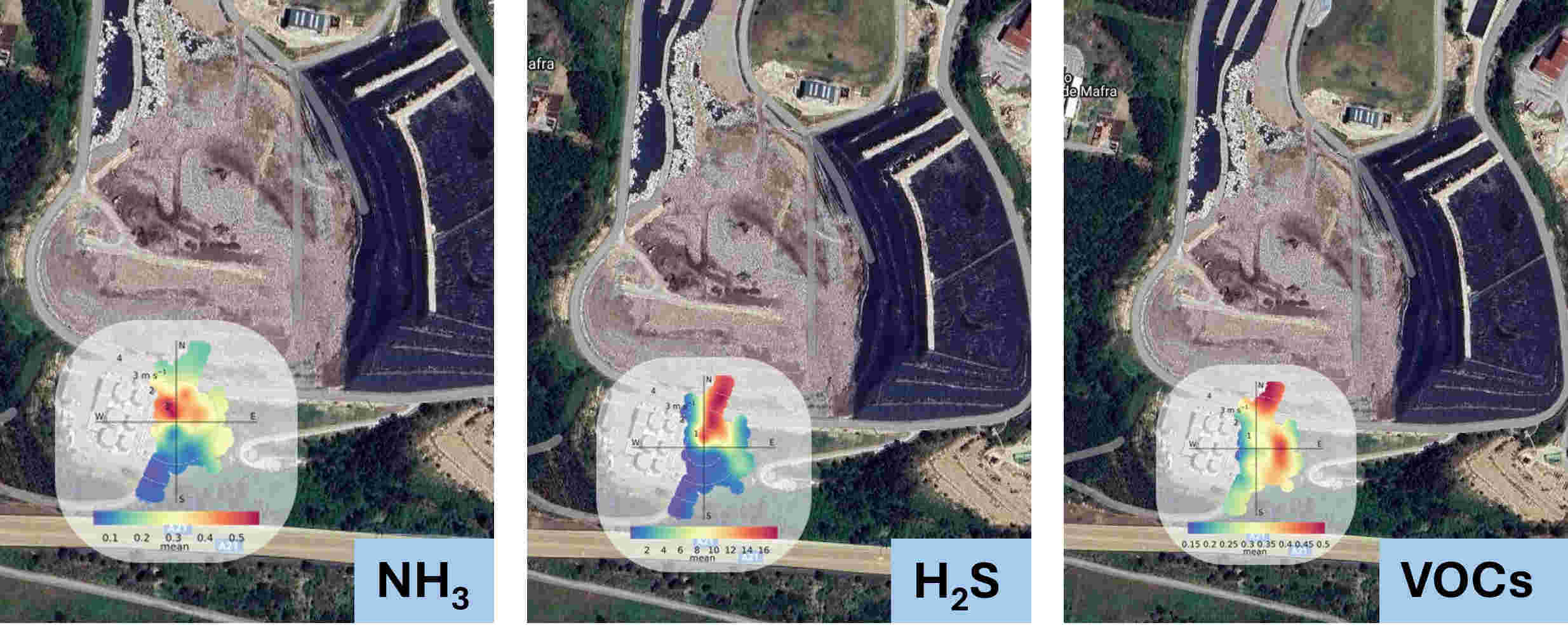
This study evaluates the use of the Kunak AIR Pro device for continuous monitoring of odorants at a wastewater treatment plant and a landfill.
The results show that sensor-based systems are effective tools for monitoring and managing odorant compounds, providing key information for corrective measures and improving air quality.
I. Lara-Ibeas*, J. Fernández-Huerta, E. Ibarrola-Ulzurrun.
Kunak Technologies, Polígono Parque Empresarial la Muga, 9, 31160 Orcoyen, Navarra
* ilara@kunak.es
Competing interests: The author has declared that no competing interests exist.
Academic editor: Carlos N. Díaz.
Content quality: This paper has not been peer-reviewed.
Citation: I. Lara-Ibeas*, J. Fernández-Huerta, E. Ibarrola-Ulzurrun, 2024, Application of sensor-based systems for continuous and accurate measurement of odorants at low concentrations, ODORA24 Conference, Barakaldo, Spain, www.olores.org.
Copyright: 2025 Olores.org. Open Content Creative Commons licence. It is allowed to download, reuse, reprint, modify, distribute, and/or copy articles in Olores.org website, as long as the original authors and source are cited. No permission is required from the authors or the publishers.
ISBN: pending.
Keywords: odour, hydrogen sulfide, ammonia, WWTP, landfill
Abstract
This study investigates the use of the Kunak AIR Pro device for continuous monitoring of odorants at a wastewater treatment plant (WWTP) and a landfill. For these applications, the sensor-based system was equipped with electrochemical sensors for hydrogen sulfide (H2S) and ammonia (NH3), a photoionization detector (PID) for volatile organic compounds (VOCs), and probes to monitor pressure, temperature, relative humidity, and wind speed and direction. At the WWTP, the device was deployed for a month, and H2S measurements were compared with those from an H2S analyzer. The results showed a high correlation (R²=0.77) and a MAE and MAPE of 6.9 ppb and 125%, respectively. The observed differences were partly attributed to the presence of sulfur organic compounds, such as mercaptans, not detected by the H2S analyzer but detected by the H2S sensor. Subsequently, the system was installed at a landfill in Lisbon to identify odour episodes and potential leaks. Continuous measurements of NH3, H2S, and VOCs, along with wind direction and speed data, revealed temporal variations and allowed for the identification of potential emission sources. This study demonstrates that sensor-based systems are effective tools for monitoring and managing odorant compounds, providing critical information for the implementation of corrective measures and improving air quality.
See the full article in other languages:
- French
- Spanish
- German
- Polish
- Arabic