 Die Innenraumluftbelastung ist eines der größten Probleme in Bezug auf die Gesundheit der Bevölkerung. Man schätzt, dass in Frankreich die Belastung der Innenraumluft sozialökonomische Kosten in Höhe von etwa 20 Billionen Euro pro Jahr verursacht. Deshalb ist die Behandlung dieser Art von Luftverunreinigung zu einer wichtigen Herausforderung geworden.
Das CUBAIR-Projekt diente dazu, einen Prototypen zu entwickeln und zu testen, der Luftreinigungsverfahren wie Adsorption, Filtration und Fotokatalyse gleichzeitig beherrscht. Die Prüfung der Leistungsfähigkeit dieses Prototypen wurde zehn Monate lang in situ durchgeführt, und es fanden verschiedene Messungen von Parametern und Schadstoffen statt wie Stickstoffoxiden und flüchtigen organischen Verbindungen, hauptsächlich BTEX und einige Aldehyde. Andere Messungen dienten zur Bestimmung von Partikelkonzentrationen (PM1, PM2.5, PM10), von mikrobiologischen Parametern, Behaglichkeitsparametern (Temperatur, relative Luftfeuchte), sowie vom Luftstrom im Prototypen. Die Ergebnisse zeigten eine gute Reinigungsleistung (RE) bezüglich Sickstoffoxiden mit einem RE von 86% für NO2. Außerdem wurde PM1 um mehr als 75% reduziert.
C. Hort1, E. Hallemans2, G. Coulbaux2, M. Binet3, V. Platel1, L. Moynault1, V. Héquet4, Y. Andres4, A. T. Luengas1, S. Lerey2, C. Neaud2
1 Univ Pau & Pays Adour / E2S UPPA, Laboratoire de Thermique, Énergétique et Procédés (LaTEP), IPRA, EA1932, 64000 Pau, France.
2 Cerema Ile-de-France –12 rue Teisserenc de Bort, 78190 Trappes-en-Yvelines, France
3 Société Air Sûr Paris Région Innovation Nord Express – 46 rue René Clair, 75018 Paris, France.
4 IMT Atlantique, DSEE, GEPEA UMR CNRS 6144 – 4 Rue Alfred Kastler, 44300 Nantes, France.
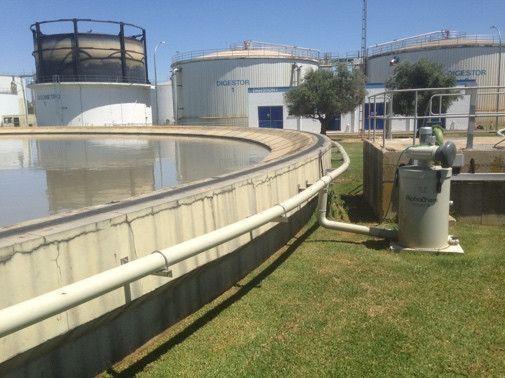 Deodorization of Waste Water Treatment Plants is becoming an increasingly important need to avoid conflicts with the neighboring environment. The primary and secondary clarifiers, due to their dimensions and concentrations of stinging gases, are units that, so far, have been quite abandoned, concerning deodorization.