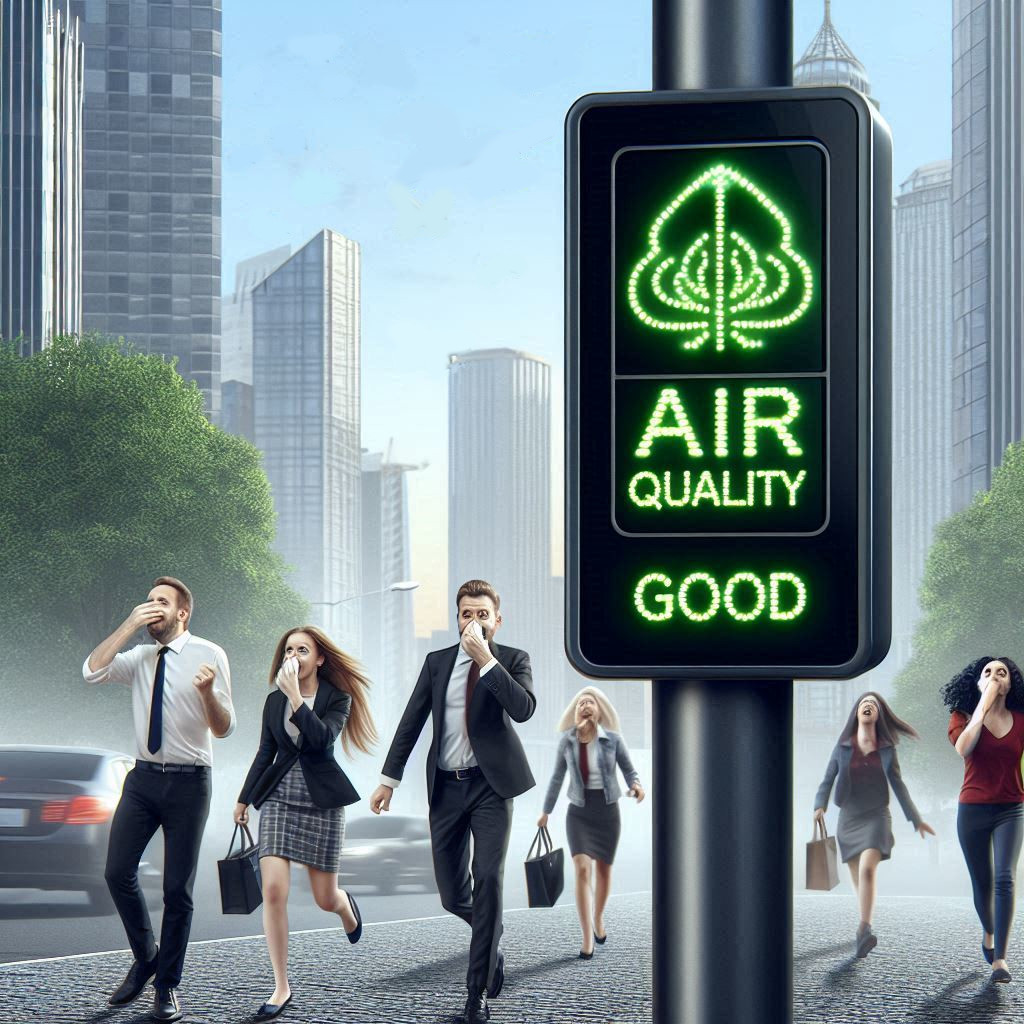
On 24 April this year, the European Parliament approved the provisional agreement on the new Air Quality (AQ) Directive. This is one of the last steps before a new Air Quality Directive is published and implemented in the 32 countries under the European Environmental Agency (EEA) umbrella. Is there anything related to odour levels in the new text of the AQ Directive?
Over the last few years, we have seen how Air Quality (AQ) panels and apps are growing around our cities. They usually show a message with AQ levels of "good," "fair," "moderate," "poor" and "very poor". These levels are much related to the existing Directive on Air Quality. This Directive is about to be replaced by a new text recently approved by the European Parliament. The question is: will this new AQ Directive incorporate any provisions regarding odour levels in ambient air?
Well, the short answer is NO. But you were expecting this, were you not? So, let's go a bit more into detail on this new directive and see what you can expect as odour manager.
If you do a quick search with the word "odour," you will get deceptive 0 results for your query. The recent developments in Germany with their new odour levels in their AQ regulation have yet to reach the European Commission. So, for the time being in Europe, there will continue to be an uncapped odour exhaust policy without any controls beyond those established under the Industrial Emissions Directive.
That said, there are, however, some parts of the text that deal with some odorants. Those are sulphur dioxide (SO2), benzene, ammonia, and other volatile organic compounds (VOCs).
SO2 maximum levels are proposed to be 20 μg/m3/year, 50 μg/m3/day and 350 μg/m3/hour, and cannot be exceeded more than 1, 3 and 18 times, respectively. This is a significant change in the ambient odour level as compared to existing levels of 20 μg/m3/year, 125 μg/m3/day and 350 μg/m3/hour that nowadays cannot be exceeded more than 1, 3 and 24 times. In any case, the odour threshold of SO2 is 1 175 μg/m3 , so if you smell it, you will need to count 18 times before being sure the AQ is compromised.
The existing European AQ directive did not mention ammonia (NH3) as a pollutant to be considered in ambient air. The proposed modification does not specify any ambient air limit of ammonia either. Still, it does recommend to measure this odorant "at monitoring supersites at urban background locations and rural background locations." Well, that is something.
As for benzene, the limit is nowadays set to be 5 μg/m3/year. The new directive proposes to decrease this concentration to 3.4 μg/m3/year. The odour threshold of benzene is 4 500 μg/m3 so it is not much of a concern for odour managers.
A list of VOCs has been included as ozone precursor substances, so no mention to their odour properties here.
Populations impacted by odour releases usually ask the regional or local environmental authorities for monitoring stations and AQ panels in the hope that they will detect the odour levels around them. The reality is that once the monitoring stations are in place, they simply do not measure ambient odour concentrations. Sometimes, they could measure odorants concentration, but this is another thing.
The reality is that if you happen to have an AQ panel nearby, they may show a "good" air quality despite the existence of odours from a Waste Water Treatment Plant, Waste Treatment, paper pulp factory or rendering, to mention a few examples of typical activities with odour not easily traceable in ambient air.
Odour is not an issue in the air quality plans or roadmaps in the coming European Directive on Air Quality. It was actually expected after some initiatives on this matter were halted by the European Commission. The good news is that a large group of scientists are working on reversing the situation.
Photo made with AI Bing image creator.
If you find this article interesting, you might also be interested in these articles.
- A new odour legislation framework in Europe? A campaign to sign a petition just started.
- New EU odour standards for large poultry and pig farms
- The European Environment Agency believes that the odours do not affect the air quality in Europe
- The First odour emission limit for 28 European countries is here
