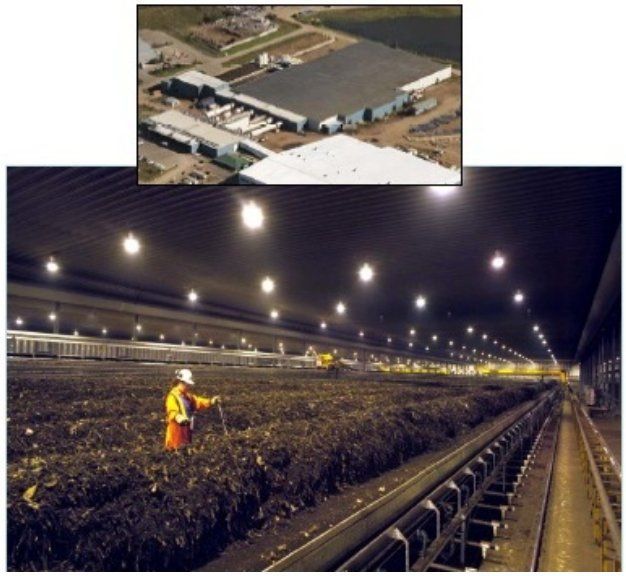
 The Edmonton Waste Management Centre (EWMC) of Edmonton, Alberta, Canada, is a unique collection of advanced waste processing and research facilities. Owned and operated by the city of Edmonton Waste Management Services, the EWMC is an integral part of Edmonton’s sustainable approach to waste management. The Centre is 233 hectares in size – 25 hectares is devoted to their composting facility, and is the largest of its kind in North America.
Odotech, a Canadian Company that produces the e-noses, announces the installation of one of their largest OdoWatch systems to date, at the EWMC. The OdoWatch system is designed to track odours from the recycling area, material transfer station and working face of the landfill.
The Edmonton Waste Management Centre, world-renowned for their innovation in waste management, has selected Odotech to help them better understand and efficiently manage, the odours emitted from their site. With greater knowledge about sources of the odours, more effective measures to mitigate those emissions can be developed.
For further information about Odotech activities you may subscribe to their blog here.
Source odotech blog
 Knowing the chemical composition of an air sample is a complex challenge because the abundance of substances of different nature and different concentrations. This complexity increases if we want to identify those compounds that cause odors, since many of them are present at very low concentrations, hardly detectable by more conventional instrumental systems. Gas Chromatography (GC) coupled at Mass Spectrometry (MS) GC-MS, is undoubtedly the more robust and consolidated technique in air sample analysis. The more common types of GC-MS are Mass Spectrometers with single quadrupole detector. However, the continuous technological development of analytical instrumentation and especially in Mass Spectrometry allows ever more robust analyses, more sensitive and with improved resolution. In recent years, the interest in GC-TOFMS systems (TOF: time-of-flight) has been increasing, because it involves a faster detector with higher sensitivity and resolution compared to the conventional single quadrupole GC-MS. This paper compares a GCO-TOFMS system recently acquired by Odournet to a more conventional GC-MS quadropolemethod. Both used thermal desorption (TD) for the chemical and sensory analysis of air samples collected in the output of biofilters. The presented results show a clear difference in terms of sensitivity and resolution for GC-TOFMS compared to a conventional GC-MS identifying almost50% more compounds in the same air sample. Additionally an analysis using GCO (GC-sniffing) was performed, showing good complementarity with the results obtained by GC-TOFMS for the same sample.
 R. López1, I. Cabeza1, J. R. Lock-Wah-Hoon1, I. Giráldez 2, M. Ruíz3, M. J. Díaz3