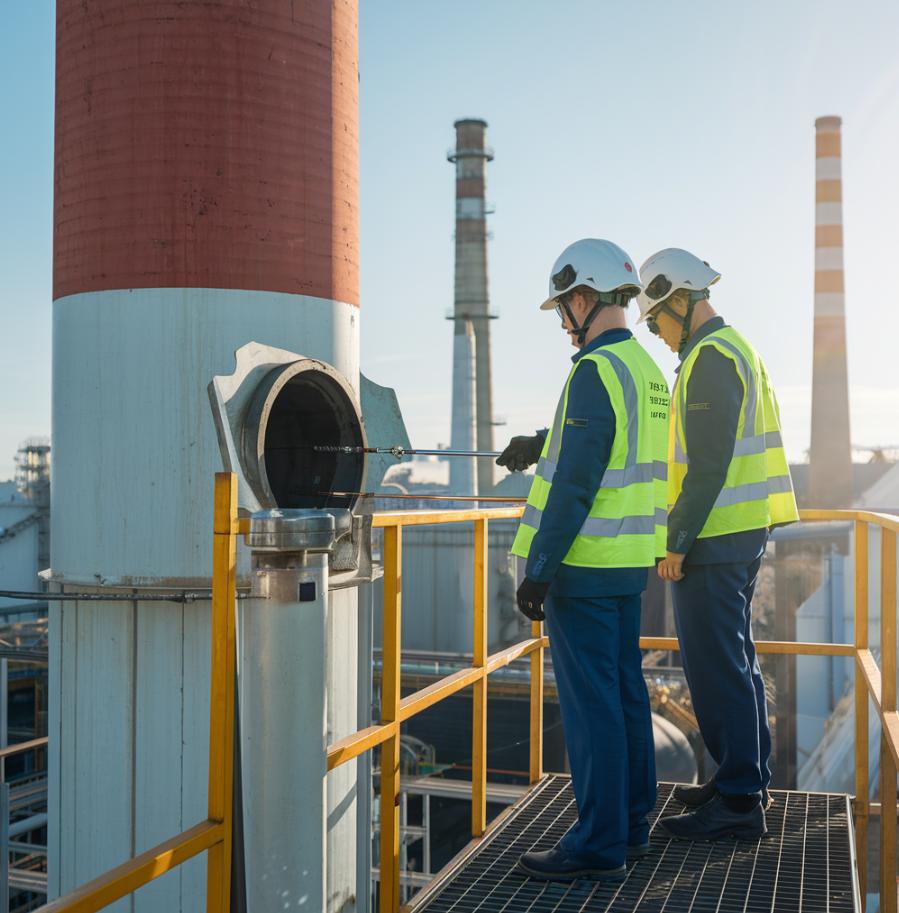
The Hessian Agency for Nature Conservation, Environment, and Geology (HLNUG) is hosting its 2025 stack emission proficiency tests (Ringversuche), offering industry professionals an opportunity to evaluate and enhance their emission measurement capabilities. Among the many tests, odour measurements take center stage with three key proficiency testing sessions scheduled throughout the year.
Every year, several tens of laboratories from around 20 different countries around the world participate in an Interlaboratory Comparison (ILC) to check proficiency according to European standard EN 13725/2003 organized by Olfasense, Lab Service or other organizations. However those ILC do not study the influence of “Sampling” on the overall uncertainty. Taking an odour sample is another parameter to take into account in the estimation of the overall uncertainty of a lab. That is why, since 2015, the Hessian Agency for the Environment and Geology (HLUG) organizes every year a regular test with tens of labs participating.
In 2025, HLNUG will be offering three distinct odour proficiency tests. The tests are structured to mimic real-world conditions, ensuring that the results provide a reliable assessment of the measurement methods. Available Odour Proficiency Test. Dates are the following:
- 25O1: 15th September – 16th September 2025 (6 places left)
- 25O2: 17th September – 18th September 2025 (5 places left)
- 25O3: 22nd September – 23rd September 2025 (7 places left)
6 hours vs 30 hours to analise the sample?
A key issue has emerged concerning the different timeframes allowed for olfactometry testing in Germany compared to other European countries. While Germany mandates that samples be analysed within six hours of collection, other European countries permit up to 30 hours for the same analysis following the EN 13725 standard. This discrepancy poses challenges for laboratories working under different regulatory frameworks.
Germany's six-hour rule is based on the country's specific regulations under the VDI 3881, which requires that odour samples be analysed within this narrow timeframe. The purpose of this standard is to ensure that the results reflect the odour’s concentration at the time of sampling, providing a snapshot that is representative of the conditions when the sample was collected. However, this requirement presents logistical challenges for laboratories outside of Germany, which may be accustomed to longer timeframes for analysis.
The rest of European countries (and possibly all around the world), on the other hand, follow the European standard EN 13725, which allows a 30-hour window for olfactometry testing. This extended period gives laboratories more flexibility when it comes to transporting and analysing samples, making it easier for them to meet the testing requirements. However, this variation in timeframes creates some operational complexities, particularly for laboratories that participate in proficiency testing programmes that require consistency across different jurisdictions.
To address these differences, HLNUG proficiency testing organisers have had to adapt by allowing laboratories to complete olfactometry testing within the 30-hour period, in line with the European standard. However, this comes with limitations. This deviation will be clearly stated in the final evaluation, which may impact the interpretation of the results, particularly with respect to their validity in Germany. More details about this here.
Why Participate?
Participating in these proficiency tests allows companies and laboratories to:
- Validate their methods: Ensure the accuracy and reliability of their odour emission measurements.
- Meet regulatory requirements: Many industries are required to demonstrate proficiency in emission testing to comply with environmental regulations.
- Enhance credibility: Successful participation in an internationally recognized proficiency test adds value to your organization's credentials and demonstrates a commitment to best practices.
How to Register?
Registration for these tests is now open, with limited spaces available for each session. The participation fee for each test is €1750, which includes all necessary testing materials and the issuance of results.
For more information or to reserve your spot, please contact Dr. Jens Cordes at pt@hlnug.hessen.de or call +49 (0)561-2000-141.
About HLNUG
The Hessian Agency for Nature Conservation, Environment and Geology (HLNUG) is dedicated to ensuring the protection of the environment through monitoring and research. Their stack emission proficiency tests play a crucial role in supporting industries and laboratories to maintain high standards in emission measurement and environmental protection.
In addition to the proficiency tests, HLNUG offers the Emission Simulation Apparatus (ESA) for rent, enabling organizations to carry out their own emission tests and training activities.
If you're interested in participating in HLNUG's odour interlaboratory comparison, we encourage you to visit their website for the upcoming schedule and registration details: https://www.hlnug.de/themen/luft/emissionen/ringversuche/proficiency-tests
If you find this article interesting, you might also be interested in these articles.
- How a European Standard about odours was born in 1991
- Interlaboratory Proficiency Tests carried out in 2014
- The first Interlaboratory Proficiency Test involving stack sampling took place the 27th to 29th of October in Kassel, Germany
- The bombshell that Mr Antonsson and his collaborators have just dropped will change the future of the next Standard EN 13725
- What happened in the odour management world in 2024
