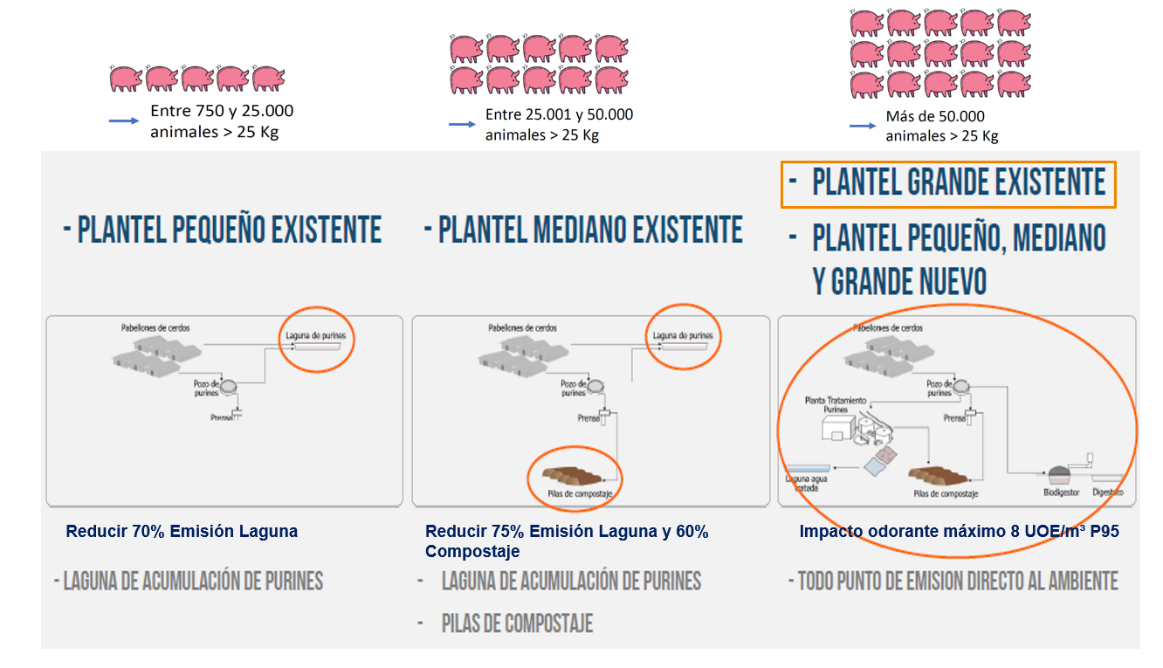
In Chile, there have been several emblematic cases related to odor episodes that have caused conflict due to their nuisance, affecting people's quality of life. In the 2022, the first pollutant emission standard for pig farms was created, but it does not guarantee the elimination of community discomfort.
Even when legal limits are met, complaints persist, so companies are advised to analyze the root causes of complaints and use meteorological data to improve their response. This way, they can better manage impacts and maintain more effective communication with the community.
A. Rivera
Ingeniero Ambiental, Licenciado en Ciencias Ambientales, Universidad de Concepción. Región de Valparaíso, Quillota, Chile.
Competing interests: The author has declared that no competing interests exist.
Academic editor: Carlos N. Díaz.
Content quality: This paper has not been peer-reviewed.
Citation: A. Rivera, 2024, MANAGEMENT OF ODOR COMPLAINTS AT PIG FARMS, A CHALLENGE BEYOND CHILEAN REGULATIONS, ODORA24 Conference, Barakaldo, Spain, www.olores.org.
Copyright: 2025 Olores.org. Open Content Creative Commons licence. It is allowed to download, reuse, reprint, modify, distribute, and/or copy articles in Olores.org website, as long as the original authors and source are cited. No permission is required from the authors or the publishers.
ISBN: pending.
Keywords: Odours, Complaint Management, Odour Impact.
Abstract
In Chile there have been several emblematic cases related to episodes of odors that have caused conflict due to their nuisance, affecting people's quality of life. In 2022, the first pollutant emission standard for pig farms was created. The standard regulates the sector but does not necessarily reduce nuisance due to bad odors among communities. This article aims to demonstrate that, even complying with the limits established by Chilean odor regulations, community complaints will persist, so productive companies must generate additional strategies against the emergence of adverse effects for both.
In summary, the findings reveal that, apart from what is required by law, it is recommended that companies be able to create and maintain a correct development of root cause analysis of the claims received, identifying on its basis, the name of the claimant, location, distance, date, time and attributable odor, to provide a better and faster response to the complainant.
It is also suggested to identify the main emission sources of potential complaints by complementing the information with public meteorological data or from own stations and/or reference or updated odor emission rates.
See the full article in other languages:
- French
- Spanish
- German
- Polish
- Arabic