Wastewater treatment configuration and operation influence the temporal variability of odour emissions from anaerobically digested biosolids.
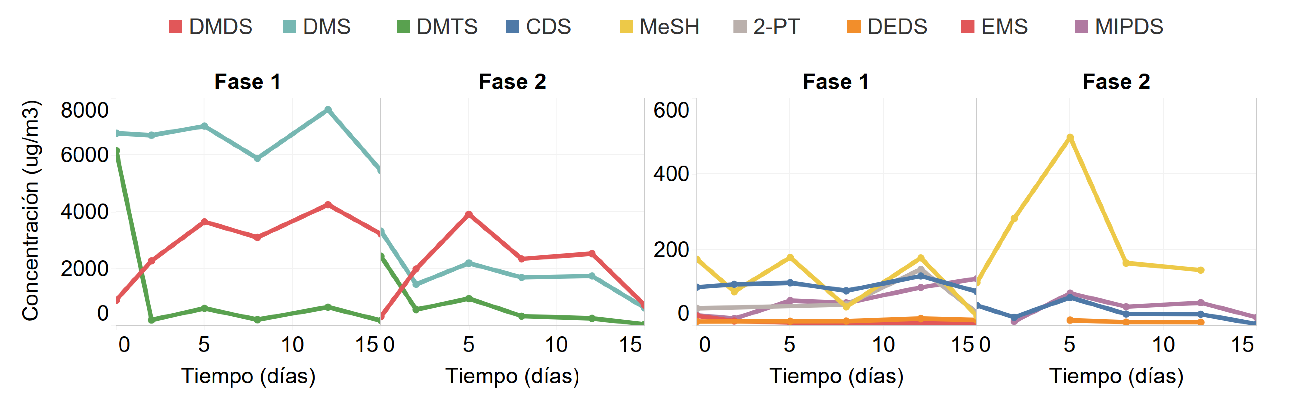
Analysis using GC-SCD, TD-GC-MS, and sensory evaluation revealed higher concentrations and detection frequencies of key VSCs (DMDS, DMS, DMTS, MeSH) during Phase 1, often exceeding odour thresholds and challenging their beneficial reuse. Extended monitoring is advised to improve management practices and support sustainable land application.
T. Guerrero1,*, R. Fisher1, A. Prata1,2 & R. Stuetz1
1UNSW Water Research Centre, Departament of Civil and Environmental Engineering, University of New South Wales – UNSW Sydney, Sydney, Australia
2Department of Environmental Engineering, São Paulo State University “Júlio de Mesquita Filho” – UNESP/Rio Claro, Brazil
Competing interests: The author has declared that no competing interests exist.
Academic editor: Carlos N. Díaz.
Content quality: This paper has been peer-reviewed by at least two reviewers. See scientific committee here.
Citation: T. Guerrero, R. Fisher, A. Prata & R. Stuetz, 2025, Investigating Odour Emissions From Biosolids For Its Sustainable Reuse, OLORES25 Congress, Santiago, Chile, www.olores.org.
Copyright: 2025 Olores.org. Open Content Creative Commons licence. It is allowed to download, reuse, reprint, modify, distribute, and/or copy articles on Olores.org website, as long as the original authors and source are cited. No permission is required from the authors or the publishers.
ISBN: pending.
Keywords: Wastewater treatment, Sludge stabilisation, Biosolids Management, Beneficial Reuse, Land application, Atmospheric emissions, Volatile compounds
Abstract
Odour emissions pose challenges to the beneficial reuse of biosolids on agricultural land, influencing operational costs and public acceptance. Factors such as management practices and stabilization treatment of wastewater sludge are crucial in odour generation. This study aimed to evaluate the effects of wastewater treatment configuration and operation on the temporal variability of odour emissions from biosolids. Emissions from anaerobically digested biosolids were analysed during two distinct time periods, phases 1 and 2, using gas chromatography-sulfur chemiluminescence detector (GC-SCD) and an olfactometric detection port, coupled with a TD-GC-MS. Panellists evaluated the intensities and descriptors of the odour events, describing the sensory characteristics of the odorants. Results showed distinct differences in concentrations and temporal trends between phases, with phase 1 consistently exhibiting higher detection frequencies and concentrations for most VSCs, notably influencing sensory perception. However, general trends between compound behaviours in the different phases were consistent. Key odorants included DMDS, DMS, DMTS, and MeSH, which persisted and frequently exceeded their odour detection thresholds, suggesting odour challenges for the beneficial reuse of biosolids. Further research, including extended sampling period and monitoring of operational parameters, is required to better understand these variations, and the effects of land application practices on the release of volatile compounds, supporting the sustainable reuse of biosolids.
See the full article in other languages:
- French
- Spanish
- German
- Polish
- Arabic