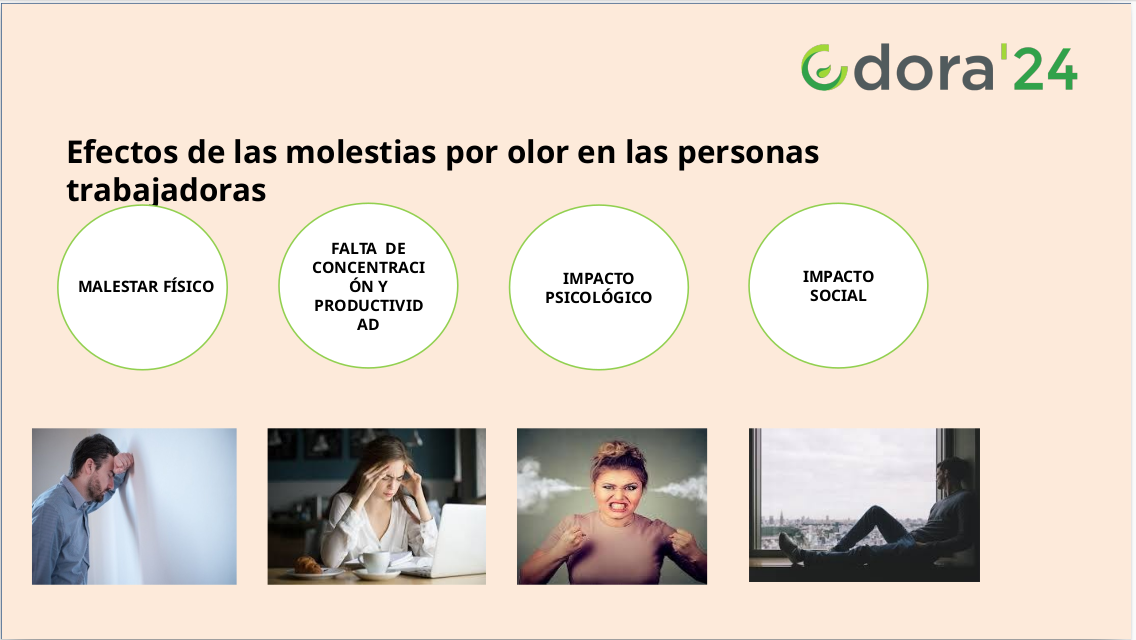
Unpleasant odours in workplaces can cause discomfort, affect workers’ physical and psychological well-being, and reduce productivity, although they are not considered a direct indicator of toxicity, and there is no specific regulation for their control.
Nevertheless, the presence of bothersome odours can lead to symptoms such as headaches or nausea in some individuals. To address the issue objectively, in 2023 a group of volunteer experts reviewed international methodologies and decided to implement a guide based on the German method and the calculation of the Odour Activity Value (OAV) to estimate the impact of the main odorants in various activities.
Gloria Sánchez*, Carlos Díaz, Ainhoa Anton, Jordi Gascon, Rodrigo Rosales, Ana Oubiña, Antonio Amo, Marc Vinot, Macarena Segarra, Irene Lara, Johana Burbano
Indoor Environmental Quality Odour Working Group, AMIGO Association, International Environmental Odour Management Society. *ssantos@amb.cat
Competing interests: The author has declared that no competing interests exist.
Academic editor: Carlos N. Díaz.
Content quality: This paper has not been peer-reviewed.
Citation: Gloria Sánchez, Carlos Díaz, Ainhoa Anton, Jordi Gascon, Rodrigo Rosales, Ana Oubiña, Antonio Amo, Marc Vinot, Macarena Segarra, Irene Lara, Johana Burbano, 2024, Indoor Air Quality Criteria for Potentially Odour-Nuisance-Generating Activities. Occupational Health, ODORA24 Conference, Barakaldo, Spain, www.olores.org.
Copyright: 2025 Olores.org. Open Content Creative Commons licence. It is allowed to download, reuse, reprint, modify, distribute, and/or copy articles in Olores.org website, as long as the original authors and source are cited. No permission is required from the authors or the publishers.
ISBN: pending.
Keywords: Indoor Air Quality, indoor environments, odors, workplace, occupational health.
Abstract
Unpleasant odour or odour with an unpleasant hedonic tone in indoor environments can cause discomfort in workplaces and affect the well-being of workers and the quality of the activities they perform. The presence of bad odour in a work environment can have various consequences for people, both at the physical, psychological, and social levels.
The perception of unpleasant odours is not considered a direct indicator of the toxic effects of a substance, so it is not used to establish indoor air quality standards. However, in individual cases, the presence of bothersome odours may be related to the appearance of symptoms such as headaches or nausea, which can affect physical and/or emotional well-being and the productivity of people in those spaces.
There is no regulation for the protection of workers against the set of risks originating from annoying odours present in the workplace.
To address these complaints objectively, in 2023, a group of volunteer technical experts and individuals related to the field of odours and ventilation met to address this issue. After a phase of meetings and a literature review from countries such as the Netherlands and Germany, where odour in indoor air quality (IAQ) has been addressed in similar ways, and a presentation on the working method in Germany, it was decided to carry out the methodology proposed in the following guide, which is based on the German methodology and the calculation of the Odour Activity Value (OAV) to estimate the most representative odorants in odour impact in various types of activities.