The Jagüel Wastewater Treatment Plant in Punta del Este, Uruguay, underwent an odor control improvement plan ahead of a major renovation.
A study by Ambiente et Odora measured H₂S emissions, modeled odor dispersion with CALPUFF, and identified key sources. Corrective actions included improved ventilation in centrifuge rooms, replacement of biofilters with granular activated carbon filters, and dosing ferric chloride into the slurry. These measures effectively reduced odors during the summer season, with no reported complaints.
A. Irigoyen*1, D. Berger1, A. Anton2, & C. Diaz2
1CIEMSA
2Ambiente et Odora
Competing interests: The author has declared that no competing interests exist.
Academic editor: Carlos N. Díaz.
Content quality: This paper has been peer-reviewed by at least two reviewers. See scientific committee here.
Citation: A. Irigoyen, D. Berger, A. Anton, & C. Diaz, 2025, Odor Management in a Wastewater Treatment Plant and Improvements Based on Previous Impact Studies, OLORES25 Congress, Santiago, Chile, www.olores.org.
Copyright: 2025 Olores.org. Open Content Creative Commons licence. It is allowed to download, reuse, reprint, modify, distribute, and/or copy articles on Olores.org website, as long as the original authors and source are cited. No permission is required from the authors or the publishers.
ISBN: pending.
Keywords: WWTP. Sewage, Modeling, Mitigation. hydrogen sulfide
Abstract
The Jagüel Wastewater Treatment Plant (WWTP), located in Punta del Este, Uruguay, operates within an area of significant real estate development. After 10 years of operation, a major revamping of the plant is planned, with a particular focus on the odor control systems. The challenge involves operating low-efficiency equipment, new environmental requirements, and mitigating potential impacts on forthcoming projects until the renovation is complete.
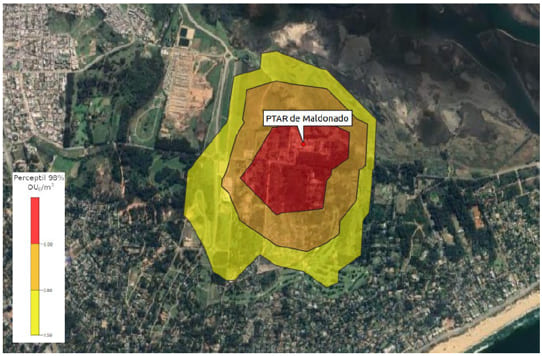
To gain a clear understanding of the emission levels and their potential effects, we collaborated with Ambiente et Odora to conduct a comprehensive study. This study assessed the significance of each emission. We conducted field measurements of hydrogen sulfide gas (H2S) and flow rates from point emission sources. Odor dispersion was modeled using the Lagrangian CALPUFF method, incorporating real environmental and meteorological data from the CALMET3D model. A map detailing the odor impact in the surrounding area was generated.
Based on the findings, we implemented corrective actions to the odor control system. The initial measures included enhancing the ventilation in centrifuge rooms and replacing the biofilters with Granular Activated Carbon (GAC) filters, previously installed as backups. The second phase involved dosing ClFe3 into the slurry.
The system operated effectively throughout the summer season, demonstrating a significant reduction in environmental odor and receiving no complaints related to odor nuisance during that time.
See the full article in other languages:
- French
- Spanish
- German
- Polish
- Arabic