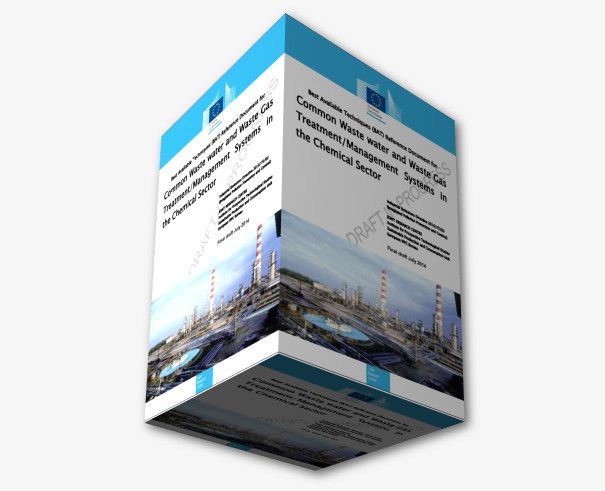
 The Commission implementing the decision establishing the Best Available Technique (BAT) Conclusions for this sector has been published on the Official Journal of the European Union. This Best Available Technique REFerence (BREF) document covers the entire chemical sector and provides information on aqueous and/or gaseous releases from chemical installations and the good news is that odour management is a key issue in the Common Waste Water and Waste Gas Treatment/Management Systems in the Chemical Sector.
As mentioned before, the BAT Conclusions (from now on, 'the Conclusions') have been published on an official journal. That makes this document a law.
There are three BAT techniques approved for odour Management for this industry: the BAT 6, the BAT 20 and the BAT 21.
The BAT 6 consist of periodically monitor odour emissions from relevant sources in accordance with EN standards. The BAT 20 consist of implementing and regularly reviewing an odour management plan, as part of the environmental management system. Finally, the BAT 21 includes the use of one or a combination of several techniques such as, minimising residence time, performing a chemical treatment, optimising the aerobic treatment, covering facilities and applying other end-pipe treatments.
About the BREF
Since there are numerous options to manage odours for waste water and/or waste gas treatment in the chemical sector, this BREF is restricted to those techniques that are 'commonly' used or applicable. Process-integrated techniques for odour control are discussed in this document when they can be used in several processes, or when their application is generally acknowledged.
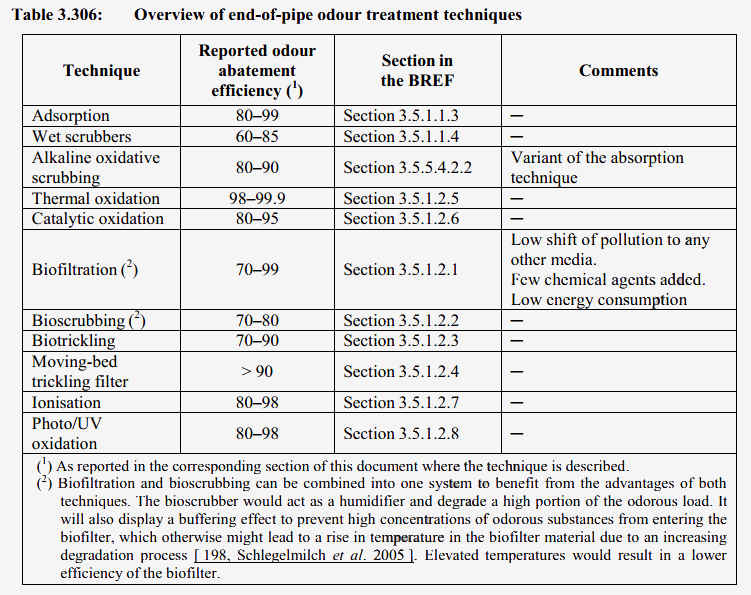
In this BREF there is a table with an overview of several end-of-pipe odour treatment techniques. Each of these techniques is described with a range of reported odour abatement efficiencies. For example, for wet scrubbers there is a reported odour abatement efficiency of 60-85%. For a biofilter the odour abatement efficiency reported is 70-99%. The following table is extracted from the BREF.
Another interesting suggestion in this BREF is the preparation of an odour management plan (OMP) as part of the environmental management system of the installation including protocols for conducting odour monitoring and for actions to identified odour incidents, an odour elimination programme and a review of historical odour incidents and remedies. The approved OMP may be made available to the public.
The approximate cost of the analysis of odours is also detailed. For example, the investment costs for the electronic nose, a weather station and the necessary software are estimated to be EUR 25 000–30 000. Costs relating to the 'learning programme' (based on the collection and analysis of 15 samples for the construction of the mathematical correlation model to express electronic nose results in odour concentrations) and to the control of the system (based on 5 samples) are estimated to be EUR 30 000.
Some techniques to prevent/reduce odour emissions from waste water collection and treatment and from sludge treatment are discussed, but just a few are considered in detail. For more info about this BREF:
- Download the BAT Conclusions (published in June 2016)
- Download the BREF document (Final Draft)
- TWG Kick-off Meeting report in June 2008
- Translation of the Executive Summary
If you find this article interesting, you might also be interested in these articles:
- The first draft of the BREF on Waste Treatment (WT) has been issued
- The final draft of the BREF for the Intensive Rearing of Poultry or Pigs (IRPP) has been published.
- How a European Norm about odours was born in 1991
- Are we there yet? Achievements and challenges in management of environmental odours
- The European Environment Agency believes that the odours do not affect the air quality in Europe.
